
Artificial intelligence in 2025 means computers that learn from data to do tasks like understanding language, recognizing images, and making decisions. If you are curious and want to try small AI projects, this guide is for you. You will get plain language, quick examples, and simple steps. We will cover a simple definition, how it works, and starter ideas you can build. Along the way, you will see how to turn curiosity into action with practical examples and clear next steps. You will also see how to pick smart goals using AI Side Project Ideas for Beginners.
At Learnaimind, we believe AI shouldn’t be intimidating. Whether you’re a student, professional, or just curious, this guide will help you understand AI basics and how it works in a practical way — no tech jargon required.
1. What Is Artificial Intelligence? A Simple Definition With Real Examples
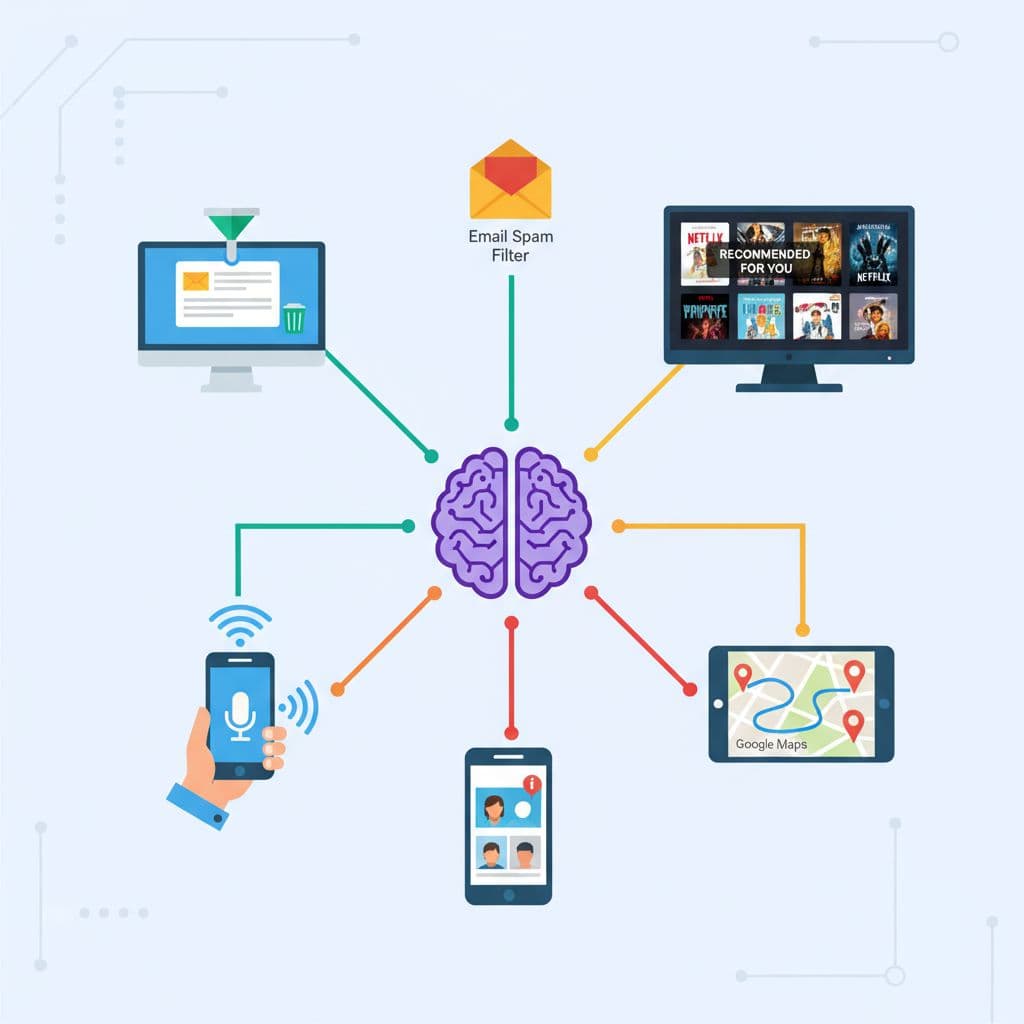
AI is the science and engineering of making systems that learn from data, then use what they learn to handle tasks that need human-like intelligence. Think of a smart intern who improves each week. You give it examples, it spots patterns, and it gets better at the job.
You do not need math or jargon to grasp the basics. Picture a large set of examples, like millions of photos or sentences. AI studies those examples and finds patterns. With more feedback, it learns which patterns work. Over time, it makes better predictions, like which email is spam or which route is fastest.
If you want a guided path, the free curriculum in AI for Beginners from Microsoft offers practical lessons and labs. Google also has quick-start materials in Learn essential AI skills, useful when you prefer short, focused learning.
Think of AI as a smart assistant — it can learn, adapt, and help you solve problems, but it needs data and instructions to do it.
Example in everyday life:
- Voice assistants like Siri or Alexa understand your commands.
- Email filters automatically sort spam from important messages.
- Recommendation systems on YouTube or Spotify suggest videos and music you’ll probably like.
2. Types of AI in Simple Words
AI isn’t just one thing — it comes in different types:
1. Narrow AI
- Also called Weak AI.
- Designed for specific tasks, like playing chess or recommending movies.
- Example: Netflix recommendation engine.
2. General AI
- Also called Strong AI.
- Can perform any intellectual task a human can do.
- Example: Still theoretical — we don’t have true general AI yet.
3. Superintelligent AI
- A futuristic AI that is smarter than humans in every task.
- Mostly seen in science fiction for now.
For beginners, most AI you’ll interact with today is Narrow AI — which is already amazing!
3. How Does AI Work? (Practical Basics)
AI works by learning from data and making predictions or decisions. Here’s a simple breakdown:
Step 1: Collect Data
AI needs examples to learn.
- Example: To recognize cats, AI needs thousands of cat images.
Step 2: Train the Model
The AI uses these examples to identify patterns.
- It “learns” the difference between cats and dogs.
Step 3: Make Predictions
Once trained, AI can predict or classify new data.
- Show it a new picture, and it can say: “This is a cat!”
Step 4: Improve Over Time
AI gets better with more data and feedback.
- The more cat photos it sees, the fewer mistakes it makes.
Practical tip for beginners:
You can try AI yourself using free tools like Teachable Machine by Google to train models without coding!
4. AI in Everyday Life
AI isn’t just for tech companies — it’s everywhere:
- Healthcare: AI helps doctors diagnose diseases faster.
- Finance: AI detects fraud and manages investments.
- Shopping: Online stores recommend products you might like.
- Transportation: Self-driving cars use AI to navigate safely.
At Learnaimind, we show beginners practical ways to explore these AI applications with simple mini projects and exercises.
5. Why Learn AI as a Beginner?
AI is changing the world, and understanding the basics can benefit anyone:
- Boost your career: Employers value AI literacy.
- Make smarter decisions: Understand how tools work and make better choices.
- Solve problems creatively: Use AI to automate tasks or analyze data.
- Stay future-ready: AI skills will be increasingly important in all fields.
6. Getting Started with AI
Here’s a simple 3-step path for beginners:
- Learn the Basics: Start with free beginner-friendly courses.
- Practice with Mini Projects: Build simple AI projects like chatbots or image classifiers.
- Stay Updated: Read blogs, join communities, and try new AI tools.
At Learnaimind, we provide all these resources for beginners — from AI basics courses, a glossary of terms, hands-on mini projects, to a friendly blog that keeps you updated.
Python Starter Projects With Free Data
- Sentiment analyzer: Classify tweets or product reviews as positive or negative. Use a small sample and track accuracy and F1.
- Digit recognizer: Train on MNIST to classify handwritten digits 0 to 9. Use a simple model and chart your errors.
- Spam classifier: Train on a public SMS dataset to flag spam vs. ham. Keep the split clean and measure precision and recall.
Use a notebook, like Jupyter. Libraries like scikit-learn and PyTorch are beginner friendly. Keep datasets small and metrics simple. If you want structured lessons, browse Learn essential AI skills for quick courses and exercises.
Project Setup Checklist
- Pick one narrow problem with a clear outcome.
- Gather or create a tiny dataset that fits the problem.
- Split data into train and test sets to avoid overfitting.
- Choose a baseline method that is simple to explain.
- Measure results with one or two metrics, like accuracy or F1.
- Write a short readme that states goal, data, method, and results.
Share Your Work and Level Up
What Is the State of AI in 2026?
If you want to understand AI today, it is important to look at current capabilities rather than rely on an older picture of the technology.
The Stanford AI Index 2026 reports rapid progress in model capabilities, including advances in science, multimodal reasoning, mathematics, and other demanding tasks. It also reports that organizational AI adoption has reached very high levels, while the pace and depth of deployment vary across industries and applications.
Generative AI adoption has also expanded rapidly, although adoption rates differ substantially across countries and populations.
But rapid progress does not mean that AI systems are always reliable.
One of the most useful ideas in recent AI research is the concept of a “jagged frontier.” AI systems can perform exceptionally well on some highly complex tasks while still making mistakes on tasks that appear surprisingly simple.
That leads to a critical lesson:
AI can be extremely capable without being consistently reliable.
Capability and reliability are not the same thing.
Where Is AI Used in the Real World?
AI is no longer limited to chatbots and content generation.
Business
AI can be used for:
- Data analysis
- Demand forecasting
- Customer support
- Workflow automation
- Personalization
- Fraud detection
- Document processing
Programming
AI can help with:
- Code generation
- Code explanation
- Debugging
- Testing
- Documentation
- Refactoring
- Software development
Healthcare and Life Sciences
AI is increasingly being explored and deployed in areas such as drug discovery, biological research, medical imaging, and clinical workflows.
However, many high-impact applications require strong validation, oversight, and domain-specific evaluation.
Education
AI can support:
- Personalized learning
- Concept explanations
- Practice generation
- Feedback
- Summarization
- Language learning
- Teacher support
The important point is that the role of AI differs substantially depending on the domain, the task, the available data, and the level of human oversight.
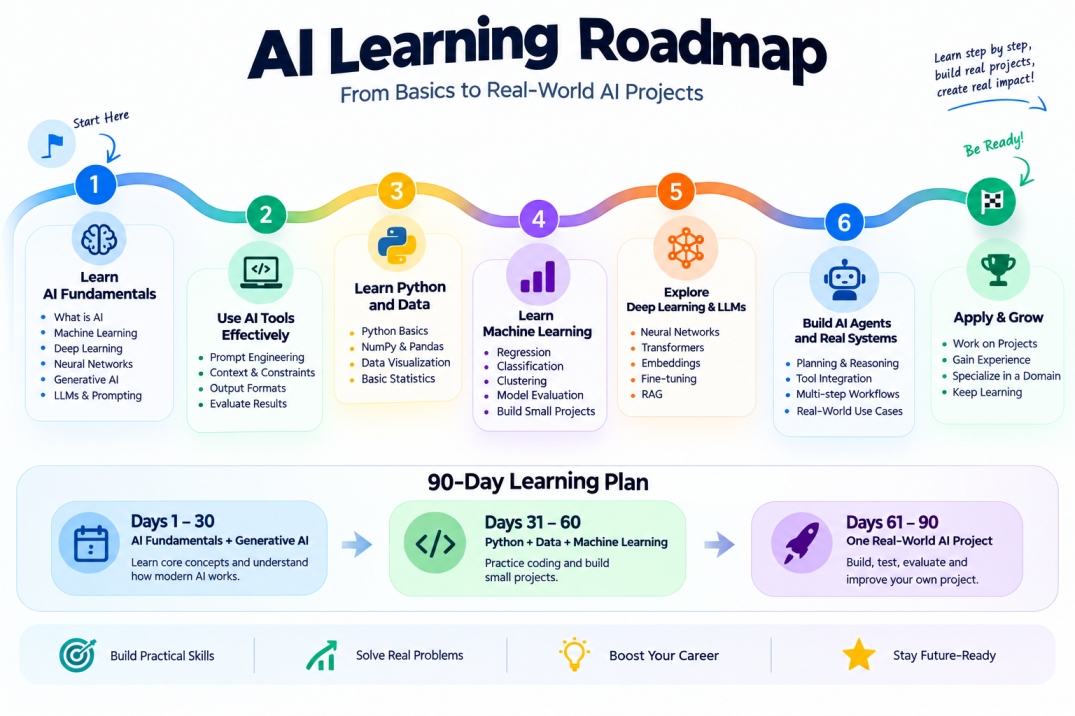
A 90-Day AI Learning Roadmap
Days 1–30
Focus on:
AI Fundamentals + Generative AI + Prompting
Learn:
- What AI is
- What Machine Learning is
- What LLMs are
- What Generative AI is
- What AI Agents are
- How to evaluate AI outputs
By the end of the first month, you should be able to explain the core concepts clearly.
Days 31–60
Focus on:
Python + Data + Machine Learning
Code regularly and build small projects.
Instead of spending all your time watching tutorials, dedicate a meaningful part of your learning time to actually building things.
Days 61–90
Focus on:
One Real-World AI Project
Examples include:
- A chatbot that answers questions about company documents
- A customer sentiment analysis tool
- An AI content assistant
- A recommendation system
- A document question-answering system
- A research assistant
- An AI agent for a specific workflow
By the end, you should have something you can demonstrate, test, evaluate, and improve.
How Much Math Do You Need to Learn AI?
The answer depends on your goal.
If your main goal is using AI professionally, you do not necessarily need advanced mathematics.
If you want to move into Machine Learning Engineering or AI Research, it is useful to learn:
- Linear Algebra
- Probability
- Statistics
- Calculus
- Optimization
For most beginners, learning the mathematics alongside practical applications is more effective than spending months studying mathematics in isolation.
What Skills Matter Most for an AI Career?
Simply “knowing AI” is not enough.
A valuable skill emerges when you combine AI with a real domain.
For example:
AI + Marketing
AI + Programming
AI + Finance
AI + Data Analysis
AI + Education
AI + Design
AI + Cybersecurity
This changes your learning from simply knowing tools to actually solving problems.
What Is the Most Important AI Skill in 2026?
A common mistake is assuming that the most important AI skill is mastering one specific tool.
The problem is that tools change extremely quickly.
More durable skills include:
Problem Solving + Data Literacy + AI Literacy + Domain Knowledge + Evaluation
In other words:
Tools change. The ability to solve problems and evaluate results lasts much longer.
This becomes even more important as AI models improve rapidly and benchmarks evolve.
What Is AI Literacy?
AI Literacy is more than knowing how to use a chatbot.
It includes being able to understand:
What AI can do.
What AI is likely to get wrong.
What information should not be shared with an AI system.
How to evaluate AI-generated content.
How to turn a real-world problem into an effective AI workflow.
AI literacy is becoming increasingly important in education, business, and regulation as AI adoption expands.
Where Is Artificial Intelligence Headed?
Based on current trends, several areas are particularly important.
1. Multimodal AI
AI systems are increasingly moving beyond text and incorporating images, audio, video, and other forms of information.
2. AI Agents
AI is moving from simple question-answering toward systems that can work through multi-step tasks and interact with tools.
3. AI in Science
AI is playing a growing role in scientific research, including work across biology, chemistry, physics, and other fields.
4. Smaller and Specialized Models
Bigger models are not automatically the best solution for every task.
Smaller, specialized, and more efficient models can be highly useful when cost, latency, privacy, or domain specialization matters.
5. Responsible AI
As AI becomes more widely deployed, issues such as:
Privacy, Security, Transparency, Safety, Evaluation, and Governance
become increasingly important.
So, What Is Artificial Intelligence?
If we reduce the entire article to a few key ideas:
Artificial Intelligence is a broad set of technologies that allows machines to use inputs and data to generate outputs such as predictions, recommendations, content, decisions, or actions.
Machine Learning is one of the major approaches used to build AI systems.
Deep Learning is a subset of Machine Learning based largely on neural networks with multiple layers.
Generative AI is designed to generate new content such as text, images, audio, video, and code.
LLMs specialize in language-related tasks and power many modern conversational and generative applications.
AI Agents represent a move toward systems that can pursue goals, plan steps, use tools, and take actions within defined environments.
And perhaps the most important lesson is:
Learning AI should not end with memorizing terminology. It should lead to the ability to solve real problems.
For a beginner, a practical path looks like this:
Understand AI → Use AI → Learn Data → Learn ML → Build Projects → Learn Advanced AI → Apply AI to Real Problems
FAQ
Is AI the same as Machine Learning?
No. Machine Learning is one major approach within Artificial Intelligence.
What is Generative AI?
Generative AI refers to AI systems that can create new content such as text, images, audio, video, and code.
What is an AI Agent?
An AI Agent is a system designed to pursue a goal by using capabilities such as planning, reasoning, information retrieval, tools, memory, and actions.
Do I need coding to learn AI?
Not necessarily.
You can use many AI tools without writing code. However, if you want to build AI systems or move into AI engineering, learning Python and data fundamentals is highly valuable.
How should a beginner start learning AI?
Start with the fundamentals, learn to use AI tools effectively, then choose your direction based on your goals.
Conclusion
Artificial Intelligence doesn’t have to be scary or complicated. By understanding AI basics, you can start applying AI in your daily life, explore exciting projects, and prepare for a future where AI is everywhere.




[…] LearnaimindAI now handles busywork in minutes, drafts emails on cue, and spins up images or videos in seconds. […]
thanks for comment
[…] AI basics and core ideas explained in plain language. […]