
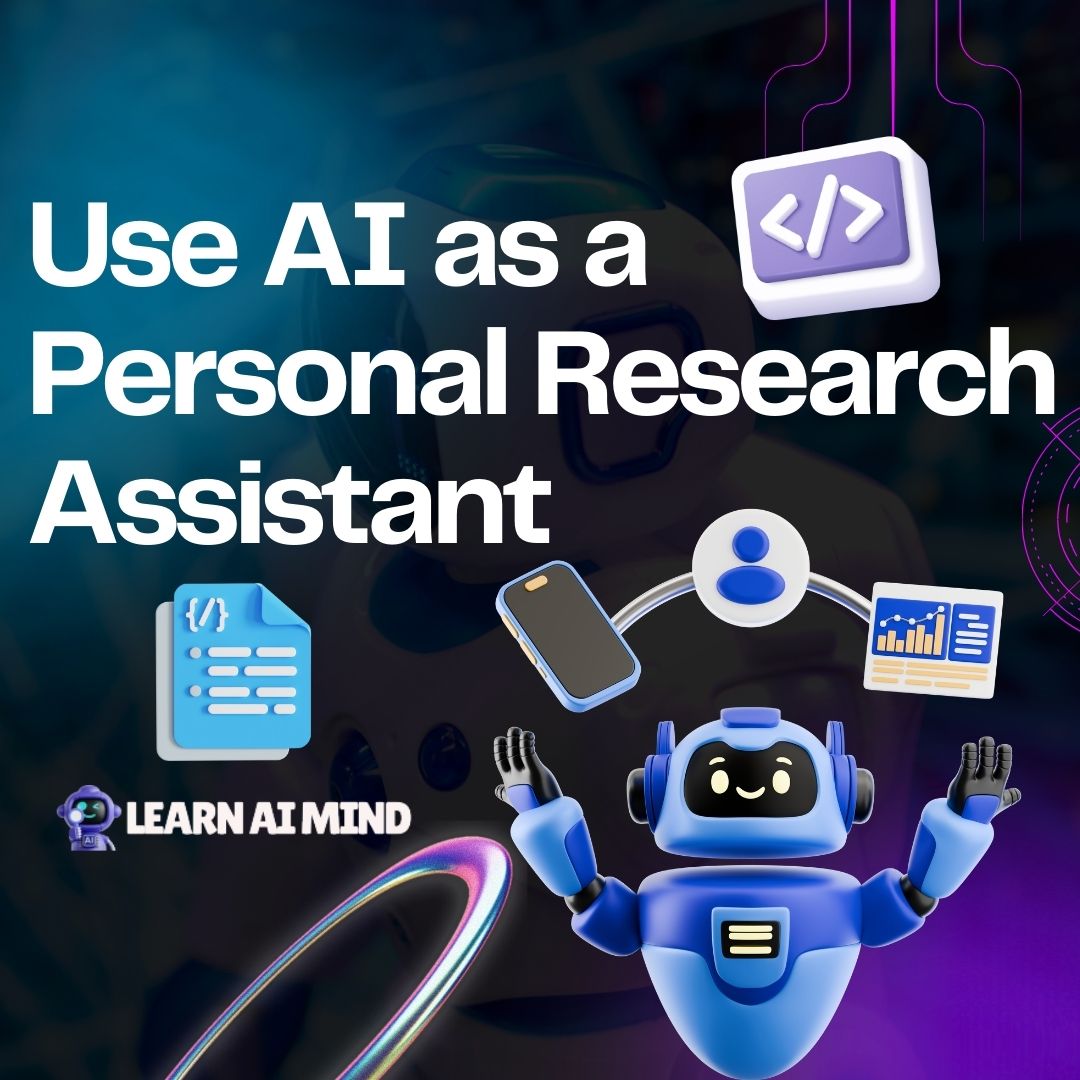
Learn how to use AI as a personal research assistant to find information faster, analyze data, summarize sources, and make smarter decisions.
LearnAIMind is your practical guide to using AI in simple, powerful ways to improve productivity, decision-making, and digital skills.
Research Doesn’t Have to Take Hours
Research used to mean:
- Opening 20 browser tabs
- Reading long articles
- Comparing multiple sources
- Taking manual notes
- Organizing scattered information
It’s slow. It’s exhausting. And it wastes time.
Now, you can use AI as a personal research assistant to gather, summarize, and analyze information in minutes instead of hours.
Whether you are:
- A student
- A business owner
- A freelancer
- A content creator
- A manager
AI can dramatically improve how you research.
Let’s break down exactly how.
If you want to discover more ways AI can improve productivity, check out our full guide on how to use AI to save time every day.
What Does It Mean to Use AI as a Personal Research Assistant?
Using AI as a research assistant means leveraging artificial intelligence tools to:
- Find relevant information
- Summarize complex topics
- Compare products or services
- Analyze trends
- Extract key insights
- Organize research notes
Instead of manually searching and filtering everything, AI helps you structure and simplify information.
Traditional Research vs AI-Assisted Research
| Traditional Research | AI-Assisted Research |
|---|---|
| Manual Google searches | Structured AI queries |
| Reading multiple full articles | Instant summaries |
| Manual comparison | Automated comparisons |
| Scattered notes | Organized output |
| Time-consuming | Time-efficient |
AI doesn’t replace critical thinking — it enhances it.
Why Use AI as a Research Assistant?
Here’s what makes AI research powerful:
- ⏳ Saves hours weekly
- 🧠 Reduces information overload
- 📚 Simplifies complex topics
- 📊 Organizes scattered data
- ⚡ Speeds up decision-making
In today’s world, speed of information processing is an advantage.
Step-by-Step: How to Use AI as a Personal Research Assistant
Step 1: Start with a Clear Question
Bad example:
“Tell me about AI.”
Better example:
“Compare the top 5 AI productivity tools for small businesses, including pricing and key features.”
Specific questions produce better results.
Step 2: Use Structured Prompts
Here are powerful prompts you can copy:
🔹 Topic Research Prompt
Provide a structured overview of [topic], including definition, key concepts, benefits, risks, and real-world examples.
🔹 Comparison Prompt
Compare [Tool A] vs [Tool B] in a table including features, pricing, pros, and cons.
🔹 Deep Dive Prompt
Explain this concept in simple terms suitable for beginners, then provide advanced insights.
🔹 Trend Analysis Prompt
Summarize current trends and future predictions related to [industry/topic].
🔹 Source Simplification Prompt
Summarize this article into 10 key points and extract actionable insights.
Best AI Tools for Research Assistance
| Tool | Best For | Free or Paid |
|---|---|---|
| ChatGPT | Flexible research & summaries | Free + Paid |
| Perplexity AI | Source-based research | Free + Paid |
| Google Gemini | Integrated search insights | Free + Paid |
| Notion AI | Organizing notes | Paid |
| Elicit | Academic research support | Free + Paid |
Different tools serve different research needs.
Real-World Use Cases
Students
- Summarize academic papers
- Prepare for exams
- Break down difficult theories
Business Owners
- Analyze competitors
- Compare software solutions
- Study market trends
Content Creators
- Research blog topics
- Analyze audience questions
- Extract insights from reports
Managers & Executives
- Review industry updates
- Summarize long reports
- Extract key action points
AI reduces research time dramatically.
Example: Research Task Comparison
Let’s say you want to research:
“Best AI tools for productivity in 2026.”
Manual Method
- 15–20 Google searches
- 10+ articles read
- 2–3 hours
- Manual note-taking
AI-Assisted Method
- Structured prompt
- Summary in 2–5 minutes
- Organized comparison table
Time saved: 1–2 hours minimum.
Advanced Strategy: Layered Research with AI
Instead of one question, use follow-ups:
- Ask for overview
- Ask for comparison
- Ask for pros & cons
- Ask for case studies
- Ask for implementation steps
This creates a structured research document quickly.
Common Mistakes When Using AI for Research
❌ Accepting answers without verification
❌ Asking vague questions
❌ Not requesting sources
❌ Over-relying on one tool
❌ Ignoring critical thinking
AI is a tool — not a final authority.
Always cross-check important information.
Security & Privacy Tips
When using AI for research:
- Avoid sharing confidential company data
- Don’t upload sensitive legal documents
- Use trusted platforms
- Review AI outputs carefully
Responsible use is essential.
FAQ: Use AI as a Personal Research Assistant
1. Is AI research accurate?
AI is generally reliable for general information, but important decisions should always be verified with trusted sources.
2. Can AI replace traditional research?
No. AI speeds up research but doesn’t replace critical thinking or fact-checking.
3. What is the best AI tool for research?
ChatGPT is flexible, while Perplexity AI is useful for source-backed research.
4. Can AI summarize academic papers?
Yes. Many tools can simplify and extract key findings from research papers.
5. How much time can AI save in research?
Depending on the task, AI can reduce research time by 50–80%.
6. Is AI good for business decision-making?
Yes, when combined with human judgment and proper verification.
7. Do I need technical skills to use AI for research?
No. Most AI tools are user-friendly and require no coding knowledge.
Conclusion: Research Smarter, Decide Faster
The future belongs to people who can process information quickly.
When you use AI as a personal research assistant, you:
- Save hours
- Reduce overwhelm
- Make better decisions
- Learn faster
- Stay ahead of competitors
AI doesn’t replace your intelligence.
It amplifies it.
Explore more practical AI guides on LearnAIMind and start researching smarter today.
Practical References
Perplexity AI Blog – AI-powered research insights and source-based searching.
HubSpot Research Blog – Data-driven marketing and research strategies.
Harvard Business Review – Articles on AI adoption and decision-making in business.