
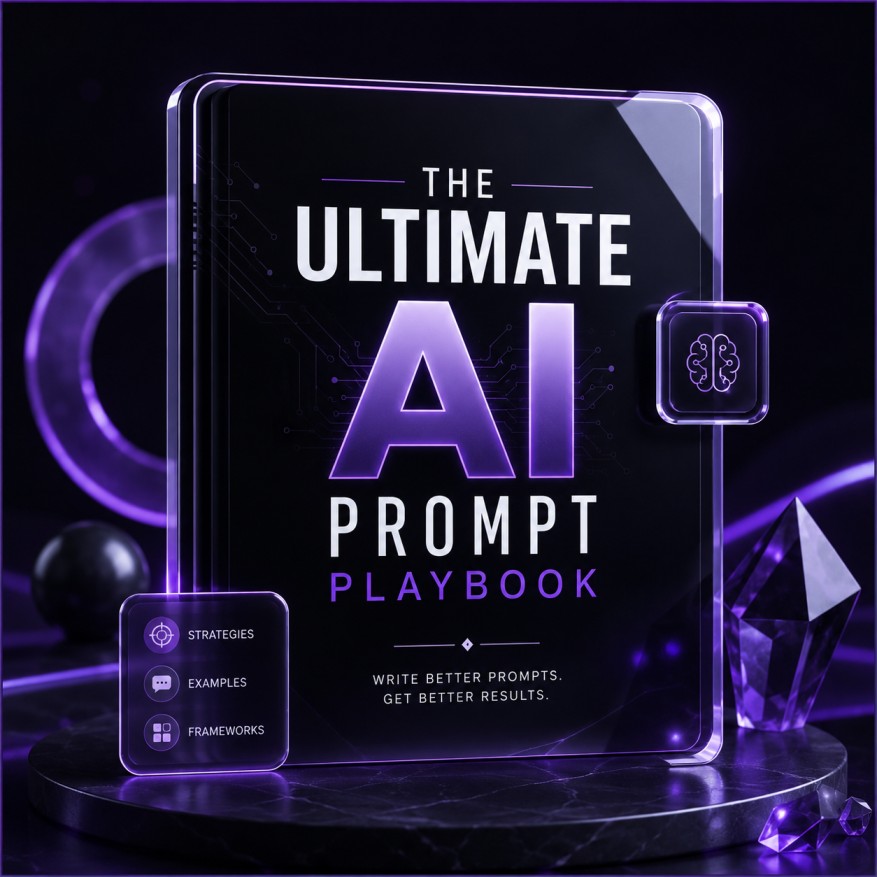
100+ Power Prompts That Save 10+ Hours Every Week
Why Most People Are Using AI Wrong
Artificial intelligence has officially crossed from novelty to necessity. Yet the gap between casual users and power users is growing exponentially — not because power users have access to better models, but because they ask better questions. The quality of your output is determined almost entirely by the quality of your prompt.
This guide is the result of thousands of hours of prompt engineering across industries — marketing, software development, content creation, finance, project management, and education. Every prompt here is battle-tested, immediately usable, and designed to deliver results you can feel in your workflow within the first 24 hours.
Whether you use ChatGPT, Claude, Gemini, or any other large language model, the frameworks in this compendium will transform how you interact with AI — permanently.
1. The Science Behind a Perfect AI Prompt
Before diving into the prompts themselves, you need to understand the anatomy of an effective instruction. Weak prompts produce generic output. Structured prompts produce professional-grade results. The difference comes down to five variables:
| Element | What It Does | Example |
|---|---|---|
| Role | Sets AI expertise context | “Act as a senior copywriter…” |
| Task | Defines the exact action | “Write a 500-word email…” |
| Context | Provides background | “Our audience is SaaS founders…” |
| Format | Specifies output structure | “Use 3 bullet points per section” |
| Constraint | Limits scope or tone | “Avoid technical jargon” |
The CRAFT Framework
To make prompt engineering second nature, use the CRAFT framework: Context → Role → Action → Format → Tone. When you apply all five dimensions, your prompts become instructions that even a new employee could follow — and AI models love that kind of clarity.
CRAFT Master Prompt:
“You are a [ROLE] with [X] years of experience in [DOMAIN]. I need you to [SPECIFIC ACTION] for [TARGET AUDIENCE]. The output should be structured as [FORMAT]. Tone: [professional / conversational / persuasive]. Length: approximately [word count]. Constraints: [anything to avoid or include]. Here is the context: [your background info].”
2. Writing & Content Creation Prompts
Content is still king — but only when it connects. These prompts help you produce high-quality written material at a fraction of the usual time, without sacrificing originality or voice.
Blog Posts & Articles
SEO Article Outline:
“You are an expert SEO content strategist. Create a comprehensive outline for a blog post targeting the keyword ‘[KEYWORD]’. Include: (1) a magnetic H1 title, (2) a meta description under 160 characters, (3) 6–8 H2 sections with 2–3 H3 sub-points each, (4) a FAQ section with 5 questions Google is likely to feature, (5) internal linking suggestions. My audience is [TARGET AUDIENCE].”
Viral Intro Hook:
“Write 5 alternative opening paragraphs for an article about [TOPIC]. Each hook uses a different psychological trigger: (1) shocking statistic, (2) controversial opinion, (3) relatable pain point, (4) compelling story, (5) bold promise. Make each under 60 words and impossible to ignore.”
Email Marketing
Cold Email Sequence:
“Act as a world-class B2B copywriter. Write a 5-email cold outreach sequence for [PRODUCT] targeting [JOB TITLE] at [COMPANY TYPE]. Email 1: Pattern interrupt. Email 2: Social proof + case study. Email 3: Address the #1 objection. Email 4: Urgency/scarcity. Email 5: Breakup email. Subject lines must be under 50 characters.”
Newsletter Edition:
“You are a newsletter editor for a [NICHE] audience of [SIZE] subscribers. Write this week’s edition covering [3 TOPICS]. Format: catchy subject line, 80-word hook intro, 3 sections of 150 words each, one actionable takeaway, and a 50-word CTA. Tone: [smart/casual/inspiring].”
Social Media
30-Day Content Calendar:
“Create a 30-day social media content calendar for [BRAND] in the [INDUSTRY] space. Platforms: [LIST]. For each day include: post type, caption, 5 hashtags, best posting time, and content format. Balance: 40% value, 40% engagement, 20% promotional.”
3. Productivity & Project Management Prompts
Time is the only non-renewable resource. These prompts are engineered to help you reclaim hours each week by automating the mental overhead of planning, prioritizing, and communicating.
Task & Priority Management
Weekly Planning Session:
“Act as my personal chief of staff. I’ll give you my task list for the week. Your job: (1) categorize each task as Deep Work / Admin / Communication / Creative, (2) apply the Eisenhower Matrix, (3) suggest a daily schedule in 90-minute focus blocks, (4) identify tasks to delegate or eliminate, (5) flag potential bottlenecks. Here is my task list: [PASTE TASKS].”
Project Kickoff Blueprint:
“I’m launching a project called [NAME]. Goal: [OUTCOME]. Deadline: [DATE]. Team: [N] people. Budget: [AMOUNT]. Create: (1) project charter, (2) work breakdown structure with milestones, (3) risk register with 5 risks and mitigation strategies, (4) RACI matrix template, (5) first-week action plan.”
Meeting Efficiency
Meeting Agenda Generator:
“Create a focused agenda for a [DURATION]-minute [MEETING TYPE] with [N] attendees. Objective: [GOAL]. Include: time-boxed agenda items, pre-read materials, decision points vs. discussion items, a parking lot section, and a closing action-items template. Ensure the meeting could be cut 30% without losing value.”
Meeting Notes → Action Plan:
“Here are raw notes from our meeting: [PASTE NOTES]. Transform them into: (1) executive summary in 3 bullets, (2) key decisions made, (3) action items table with Owner / Task / Deadline / Priority, (4) open questions for follow-up, (5) draft follow-up email to all attendees.”
4. Coding & Technical Prompts
For developers, AI is the ultimate pair programmer. These prompts supercharge your coding workflow — from writing clean code to debugging production nightmares.
Code Review & Refactor:
“You are a senior software engineer specializing in [LANGUAGE/FRAMEWORK]. Review this code for: (1) bugs and security vulnerabilities, (2) performance bottlenecks, (3) code smell and anti-patterns, (4) missing edge cases, (5) documentation gaps. Then provide a refactored version with inline comments explaining each change. Code: [PASTE CODE]”
Debugging Assistant:
“I have a bug I cannot solve. Language: [LANGUAGE]. Error message: [ERROR]. Expected behavior: [EXPECTED]. Actual behavior: [ACTUAL]. Things I’ve tried: [LIST]. Walk me through your diagnostic process, suggest 3 possible root causes ranked by likelihood, and provide a fix for each.”
System Design Architect:
“Design a scalable system architecture for [APP DESCRIPTION]. Expected load: [USERS/DAY]. Budget tier: [TIER]. Include: (1) high-level architecture diagram (text-based), (2) tech stack with justification, (3) database schema for core entities, (4) API endpoint structure, (5) scalability considerations, (6) estimated infrastructure cost.”
5. Marketing & Business Strategy Prompts
Marketing is storytelling at scale. Business strategy is chess. These prompts help you think at the level of the best strategists — without a consultant’s price tag.
Ideal Customer Profile Builder:
“Help me define my ICP for [PRODUCT/SERVICE]. Generate: (1) primary ICP with 12 attributes — demographics, firmographics, psychographics, pain points, goals, buying triggers, (2) secondary ICP, (3) negative persona (who NOT to target), (4) Jobs-To-Be-Done framework, (5) 10 interview questions to validate this ICP.”
Competitor SWOT Analysis:
“Conduct a deep SWOT analysis for [COMPETITOR] in the [MARKET] space. Compare against us: our strengths are [LIST], our weaknesses are [LIST]. Output: SWOT matrix, competitive positioning map, top 3 opportunities we should exploit, top 2 threats to defend against, and a 90-day response strategy.”
Sales Objection Handler:
“I sell [PRODUCT] to [BUYER TYPE]. The most common objection I hear is: ‘[OBJECTION]’. Give me: (1) the psychology behind why prospects say this, (2) 5 different responses from empathetic to assertive, (3) a follow-up question that keeps the conversation moving, (4) a proof point or case study template I can use.”
6. Learning & Research Prompts
AI is the world’s greatest tutor — if you know how to use it. These prompts turn any topic into a personalized curriculum that fits your learning style and timeline.
Accelerated Learning Curriculum:
“I want to become proficient in [SKILL] within [TIMEFRAME]. My current level: [BEGINNER/INTERMEDIATE]. I can dedicate [HOURS/WEEK]. Create: (1) a 4-phase learning roadmap, (2) top 5 resources per phase, (3) weekly project milestones, (4) assessment questions to test comprehension, (5) the 20% of concepts that deliver 80% of the results.”
Research Deep Dive:
“I need to deeply understand [TOPIC] for [PURPOSE]. Provide: (1) the 5 most important things to know, (2) common misconceptions to unlearn, (3) the most credible sources and thought leaders, (4) a key terminology glossary, (5) how this connects to [RELATED FIELD], (6) 3 contrarian perspectives I should consider.”
Socratic Debate Partner:
“I believe that [POSITION]. Challenge me rigorously. Steelman the opposing view. After I respond to each point, escalate the difficulty of your counter-arguments. At the end, evaluate the strength of my final position on a 1–10 scale and tell me the single most important thing I missed.”
7. Creative & Design Thinking Prompts
Creativity isn’t a talent — it’s a process. These prompts unlock lateral thinking, generate original ideas, and help you solve problems from angles you’d never consider alone.
Idea Storm (Divergent Thinking):
“I need breakthrough ideas for [PROBLEM/GOAL]. Use these 6 ideation techniques and give me 5 ideas per technique: (1) SCAMPER method, (2) First Principles Thinking, (3) Analogical Reasoning — what would [INDUSTRY X] do?, (4) Worst Possible Idea inversion, (5) Random word association, (6) ‘What if all constraints disappeared?’ Then identify the top 3 ideas worth prototyping.”
Product Naming Workshop:
“Help me name a [PRODUCT TYPE] for [TARGET MARKET]. Core value proposition: [1 SENTENCE]. Brand personality: [3 ADJECTIVES]. Competitors to differentiate from: [LIST]. Generate 25 name options across: Descriptive, Metaphorical, Coined, Acronym, Founder-based, Emotional. For the top 5, include domain availability considerations, trademark risk notes, and tagline suggestions.”
8. Personal Development & Career Prompts
The most successful people invest relentlessly in themselves. These prompts serve as your AI life coach, career strategist, and personal board of advisors.
Career Pivot Roadmap:
“I currently work as [CURRENT ROLE]. I want to transition into [TARGET ROLE] within [TIMEFRAME]. My transferable skills: [LIST]. Create: (1) skills gap analysis with a learning plan, (2) portfolio project ideas that bridge both worlds, (3) target companies and networking strategy, (4) resume positioning framework, (5) a 30/60/90-day action plan.”
Performance Review Prep:
“Help me prepare for my annual performance review. Role: [TITLE]. Key accomplishments: [LIST]. Challenges faced: [LIST]. Goals I want to set: [LIST]. Generate: (1) accomplishment statements using the STAR method, (2) quantified impact metrics to highlight, (3) 3 strategic asks — raise/promotion/resources, (4) responses to likely tough questions.”
Negotiation Strategy:
“I am negotiating [CONTEXT: salary/contract/deal]. My goal: [YOUR GOAL]. Their likely position: [THEIR GOAL]. My BATNA: [ALTERNATIVE]. Develop: (1) opening offer strategy, (2) concession ladder, (3) 5 likely objections with tactical responses, (4) red lines I must not cross, (5) closing language to lock in the deal.”
Pro Tips: Advanced Prompt Engineering
Chain of Thought — Add “Think step by step” to any complex problem. AI performs significantly better on multi-step reasoning when explicitly asked to show its work.
Role Stacking — “You are both a [ROLE A] and a [ROLE B]. Approach this problem from both perspectives and synthesize your findings.” This produces richer, more nuanced output.
Output Anchoring — Provide an example of what good looks like: “Here’s an example of the style I want: [EXAMPLE]. Now write [YOUR CONTENT] following this style exactly.”
Iterative Refinement — Never accept first output as final. Follow up with: “This is good. Now make it 30% shorter, more punchy, and replace any generic phrases with specific, concrete examples.”
Temperature Control via Language — Want creative output? Say “Be wildly creative, break conventions.” Want precision? Say “Be conservative and cite only established facts.”
Your Time Savings: By the Numbers
| Task | Without AI | With AI Prompts | Saved |
|---|---|---|---|
| Writing a blog post (1,500 words) | 4 hours | 45 minutes | 3h 15m |
| Research & competitive analysis | 3 hours | 30 minutes | 2h 30m |
| Weekly planning & scheduling | 1.5 hours | 15 minutes | 1h 15m |
| Drafting 10 emails | 1.5 hours | 20 minutes | 1h 10m |
| Code review (200 lines) | 2 hours | 25 minutes | 1h 35m |
| Meeting prep & follow-up | 1 hour | 12 minutes | 48 minutes |
| Total per week | 13 hours | ~2.5 hours | 10+ hours |
Start Today, Not Tomorrow
The professionals winning in 2025 aren’t smarter — they’re more leveraged. They’ve built systems that multiply their output without multiplying their hours. AI is the highest-leverage tool ever handed to a knowledge worker.
The prompts in this compendium aren’t magic spells — they’re frameworks. The more you customize them to your voice, your industry, and your workflow, the more powerful they become. Start with the section most relevant to your immediate challenge. Test one prompt today. Refine it tomorrow. Build your personal library of prompts that work for you.
The question isn’t whether AI will change your industry. It already has. The only question is whether you’ll be the one steering it — or the one being disrupted by it.
Save this guide. Share it with your team. Revisit it every quarter. Your future self will thank you for the hours you got back.
Want the Full Power? Download All 100+ Prompts Now.
You’ve seen a preview of what’s possible — but this is just the surface. The complete PDF compendium includes 100+ fully customizable, copy-paste-ready prompts across every category covered in this guide, plus 3 exclusive bonus sections: AI Prompts for Finance & Budgeting, HR & Recruitment, and Customer Support Automation. Every prompt comes with fill-in-the-blank placeholders, real-world usage examples, and pro tips to get the best output on your first try. No fluff, no filler — just the exact prompts used by top marketers, developers, and entrepreneurs to reclaim 10+ hours every single week. Click the button below to download your free copy and start saving time today.