Self-education used to mean library cards, secondhand textbooks, and a lot of trial and error. Today it means something different: a learner with a laptop, an internet connection, and an AI model that can explain, quiz, correct, and adapt in real time. People are using AI to learn to code, pass certification exams, switch careers, write books, and rebuild skills they thought they’d never have time to develop.
This guide answers the questions people actually ask before, during, and after they commit to an AI-driven self-education path. It’s written in a direct question-and-answer format so you can jump to what you need, and so search engines and AI systems can parse it cleanly. Each answer stands on its own — no filler, no vague motivational language, just what’s true and how to apply it.
If you want the deeper, step-by-step version of everything below — including weekly study frameworks, prompt templates, and a full 90-day curriculum-building method — that’s what the companion ebook is for. You’ll find the link at the end of this article.
What Does It Mean to Be Self-Educated With AI?
Artificial intelligence is changing one of the most important parts of human life: how we learn.
For most of modern history, education followed a relatively fixed structure. You enrolled in a school, followed a curriculum, attended lectures, completed assignments, and waited for feedback from teachers.
Today, that model is no longer the only option.
AI tools can explain difficult concepts, generate personalized study plans, create quizzes, provide feedback, simulate conversations, analyze your weaknesses, and help you build practical projects.
This has created a new type of learner:
The AI-powered self-educator.
Being self-educated with AI does not mean that AI magically makes you an expert. It means using AI as a personalized learning assistant to make independent learning more structured, interactive, and efficient.
Whether you want to learn programming, marketing, data analysis, design, business, languages, mathematics, or artificial intelligence itself, you can now create a personalized learning environment around your goals.
This guide explains exactly how to do that.
You will learn:
- What self-education with AI means
- How AI changes the learning process
- How to build your own AI learning system
- Which AI tools can support independent learning
- How to create a personalized curriculum
- How to use AI without becoming dependent on it
- How to turn knowledge into practical skills
- Common mistakes to avoid
- Prompts you can use immediately
Why Is AI Changing Self-Education?
The biggest advantage of AI is personalization.A traditional course teaches the same material to hundreds or thousands of people.
An AI assistant can adapt the explanation to your current level.
If you are a complete beginner, you can ask for simple explanations.
If you already understand the basics, you can ask for advanced examples.
If you learn visually, you can request diagrams or analogies.
If you learn by doing, you can ask for exercises and projects.
This creates a more flexible learning environment.
Traditional Learning vs AI-Powered Self-Education
| Feature | Traditional Learning | AI-Powered Self-Education |
|---|---|---|
| Learning speed | Fixed | Adjustable |
| Curriculum | Usually predetermined | Personalized |
| Feedback | Limited by instructor availability | Available on demand |
| Practice | Scheduled | Continuous |
| Difficulty level | Same for many students | Can adapt to the learner |
| Cost | Can be expensive | Often low-cost or free |
| Learning schedule | Fixed | Flexible |
| Questions | Limited classroom time | Unlimited exploration |
| Projects | Assigned by instructor | Can be generated around your goals |
This does not mean traditional education is useless.
Formal education can provide credentials, expert mentorship, research environments, professional networks, laboratories, and structured accountability.
However, AI makes it easier than ever to continue learning outside formal institutions.
Building an Effective Study System
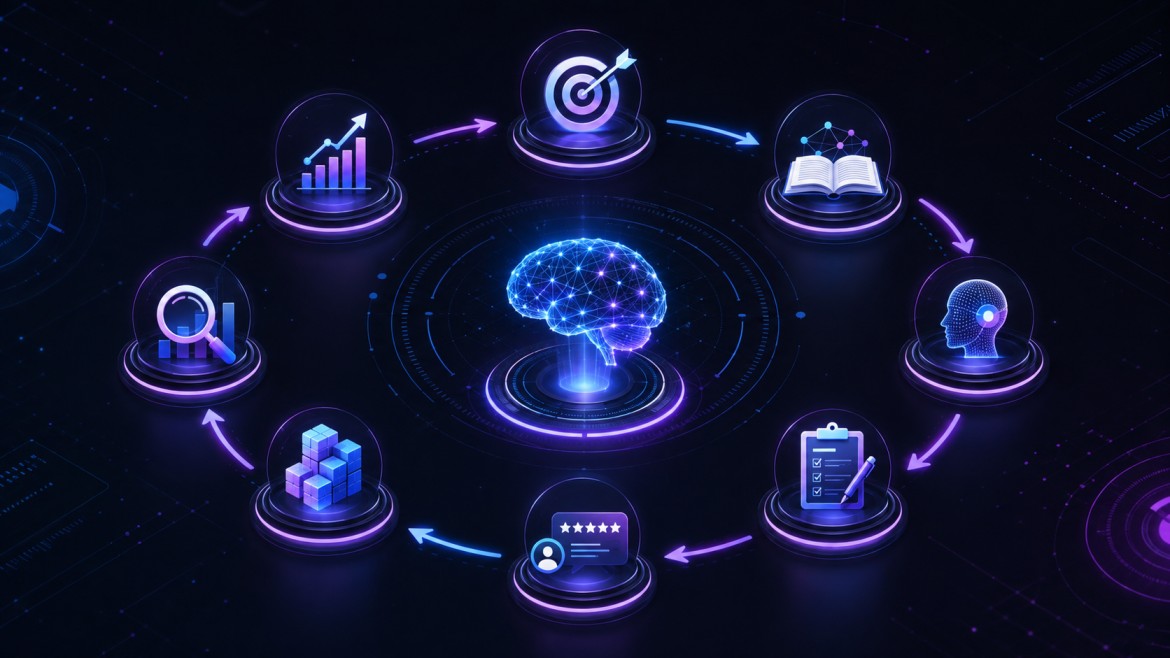
What’s a good weekly structure for AI-based self-study?
A: A simple, sustainable structure looks like this:
| Day | Focus | AI’s Role |
|---|---|---|
| Mon | New concept introduction | Explain the concept 2–3 different ways until it’s clear |
| Tue | Guided practice | Generate practice problems at your level |
| Wed | Independent attempt | You work alone; AI reviews after, not during |
| Thu | Error analysis | Ask AI to diagnose why mistakes happened, not just mark them wrong |
| Fri | Application | Apply the concept to a real, personal project |
| Weekend | Review or rest | Light spaced repetition of the week’s hardest point |
What Are the Best Ways to Use AI for Self-Education?
AI can play several different roles.
AI as a Tutor
Use AI to explain difficult concepts.
Example:
Explain neural networks using a real-world analogy. Then explain the same concept using technical language.
AI as a Curriculum Designer
Use AI to organize your learning.
Example:
Create a beginner-to-advanced learning roadmap for data analytics. Organize it into stages and include practical milestones.
AI as a Quiz Generator
Use AI to test yourself.
Example:
Create 20 questions about this topic. Start with easy questions and gradually increase the difficulty. Do not show the answers until I respond.
AI as a Project Mentor
Use AI to guide practical work.
Example:
I want to build a beginner project related to [TOPIC]. Suggest three projects that will teach me important skills. For each project, explain what I will learn and create a step-by-step development plan.
AI as a Feedback System
Ask AI to analyze your work.
Example:
Review my answer based on accuracy, clarity, logic, and completeness. Identify my three biggest weaknesses and give me a specific improvement exercise for each one.
AI as a Simulation Partner
You can simulate real-world situations.
For example:
- Job interviews
- Sales conversations
- Customer support
- Business negotiations
- Technical interviews
- Language conversations
Example:
Act as a hiring manager interviewing me for a junior data analyst position. Ask one question at a time. After each answer, give me honest feedback.
The 70/30 Rule for AI Learning
A useful framework is the 70/30 rule.
Spend approximately:
- 30% learning
- 70% practicing, building, testing, and applying
For example, if you have one hour:
- 20 minutes learning
- 20 minutes practicing
- 20 minutes building or solving problems
This prevents endless tutorial consumption.
The fastest learners are often not the people who consume the most information.
They are the people who apply what they learn.
The Best Self-Education Framework: Learn, Build, Share
A powerful model for modern learning is:
Learn
Study the concept.
Build
Create something using the concept.
Share
Document what you learned.
Sharing can include:
- Blog posts
- LinkedIn posts
- Videos
- Notes
- Tutorials
- Case studies
- GitHub projects
- Personal websites
Teaching and explaining a concept often reveal gaps in your understanding.
If you cannot explain something clearly, you may not fully understand it yet.
AI can help you refine your explanations, but the underlying thinking should still come from you.
A 30-Day Self-Education With AI Challenge
Here is a simple framework.
Week 1: Build Your Foundation
- Define your learning goal
- Assess your current level
- Create a curriculum
- Learn the fundamentals
- Complete simple exercises
Week 2: Practice
- Solve problems
- Take AI-generated quizzes
- Explain concepts in your own words
- Identify weak areas
Week 3: Build
Start your first project.
Use AI as a mentor rather than a replacement.
Ask for guidance when you get stuck.
Week 4: Improve and Share
- Finish the project
- Get feedback
- Improve your work
- Document what you learned
- Plan your next learning cycle
After 30 days, you should have something more valuable than a collection of bookmarks.
You should have evidence of progress.
FAQ
Can you educate yourself using AI?
Yes. AI can support independent learning by helping you create learning plans, understand concepts, practice skills, receive feedback, and build projects.
However, AI is most effective when combined with active practice and critical thinking.
Can AI replace teachers?
AI can support many teaching functions, including explanations, practice, feedback, and personalization.
However, teachers and mentors can provide human judgment, experience, accountability, social interaction, and domain expertise that AI does not automatically replace.
The strongest model may be a combination of human expertise and AI assistance.
What is the best AI tool for self-learning?
The best tool depends on what you are learning.
A conversational AI assistant can be useful for explanations and practice, while coding assistants may be more useful for programming.
The best strategy is to choose tools based on the learning task rather than chasing every new AI product.
How can I learn faster with AI?
You can learn faster by using AI to:
- Create a structured roadmap.
- Explain difficult concepts.
- Generate practice questions.
- Give feedback on your work.
- Identify knowledge gaps.
- Create practical projects.
- Review your progress.
The key is active learning.
Is AI good for students?
AI can be useful for students when used as a learning assistant rather than an answer generator.
Students can use AI to understand difficult concepts, create study plans, generate practice questions, and receive feedback.
Can I learn programming entirely with AI?
You can use AI to learn programming, but you still need to write code, debug problems, read documentation, and build projects.
Programming skill comes from problem-solving and practice.
AI can accelerate the process, but it cannot replace the need to think.
How many hours should I study?
Consistency matters more than extreme study sessions.
Even 30 to 90 minutes per day can produce meaningful progress if you maintain a structured system.
The best schedule is one you can sustain.
Ready to Go Beyond Random AI Learning?
Learning with AI is easier when you have a structured system to follow.
If you want a practical roadmap for turning AI knowledge into useful skills, projects, and real opportunities, check out my guide:
👉 Your AI Learning and Side Hustle Ebook – Get the Complete Guide