
Welcome to LearnAiMind – your guide to smarter business growth, practical AI tools, and digital marketing strategies that deliver real value.
Marketing today is about more than creating content and posting on social media. Businesses need to understand their audience, produce valuable content, improve search visibility, manage campaigns, and turn visitors into customers. Doing all this manually can quickly become overwhelming, especially for small teams.
This is where the best AI tools for marketing can make a real difference. They help marketers generate ideas, create content, analyze performance, and automate repetitive tasks without building a larger team.
But here is the important part: the best AI marketing tool is not necessarily the one with the most features. It is the one that solves your biggest marketing problem.
In this guide, we will explore seven practical AI marketing tools, what each one does best, and how to use them in a real marketing workflow.
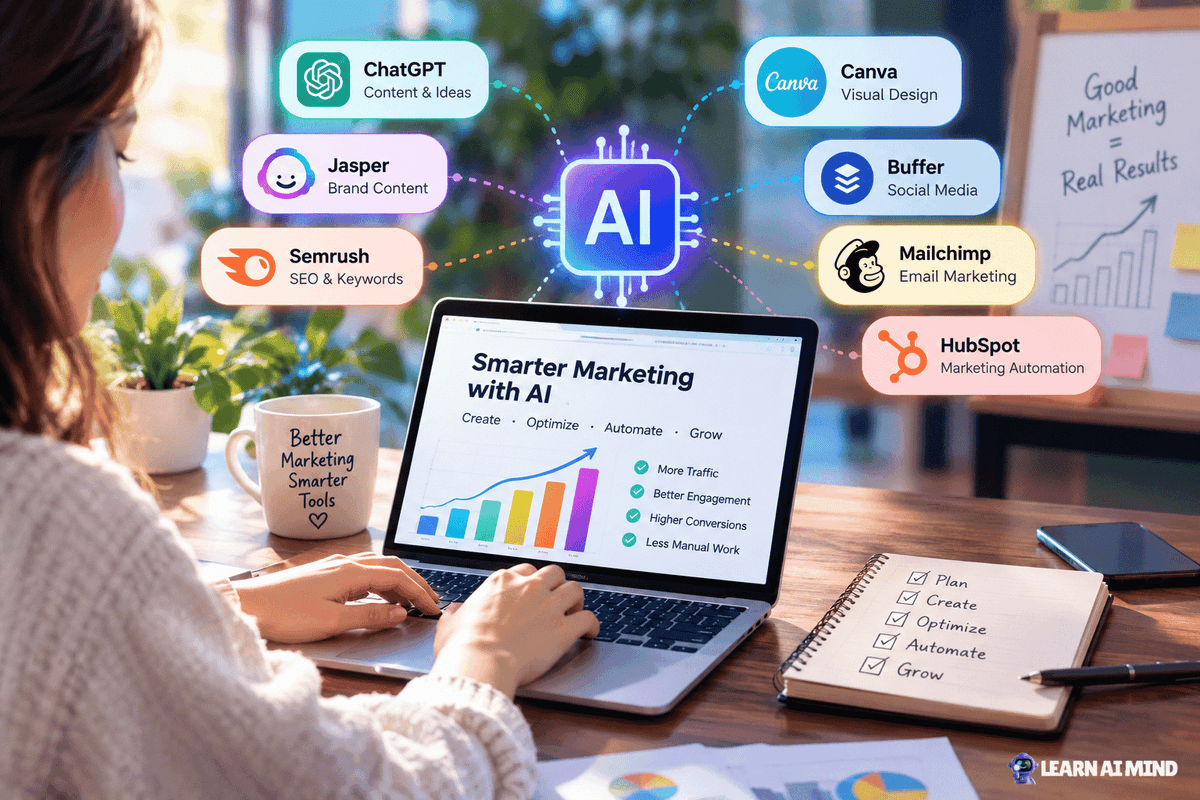
7 Best AI Tools for Marketing
1. ChatGPT: Best for Marketing Ideas and Content Creation
ChatGPT is a versatile starting point for marketers who need help with research, campaign planning, copywriting, and content development.
Instead of staring at a blank page, you can use it to brainstorm blog topics, create campaign outlines, write email drafts, develop social media captions, and adapt messaging for different audiences.
For example, imagine you run a small online business and want to promote a new product. ChatGPT can help you develop several campaign angles, suggest audience-specific messages, and prepare a first draft for each marketing channel.
Practical tip: Avoid prompts such as “Write a marketing post.” Give the AI more context about your audience, offer, tone, and objective.
Try this prompt:
“Act as a marketing strategist for a small e-commerce business selling . Our target audience is [audience]. Create three campaign ideas, each with a clear customer problem, key message, and call to action. Keep the messaging specific, natural, and benefit-focused.”
ChatGPT is particularly useful when you need flexibility across different marketing tasks. However, important claims, customer insights, and final copy should always be reviewed by a human.
Best for: Marketing brainstorming, copywriting, content planning, research, and campaign development.
2. Jasper: Best for Consistent Brand Messaging
Creating content is one challenge. Keeping every email, advertisement, landing page, and social post consistent with your brand is another.
Jasper is designed specifically for marketing teams that need to produce and manage content at scale. Its marketing-focused workflows and brand context features help teams create content that follows established messaging and style guidelines.
This can be especially valuable when multiple people contribute to marketing campaigns. Rather than reinventing your brand voice for every asset, you can establish guidelines and use them to inform content creation.
For example, a company that publishes weekly blog posts and runs regular email campaigns can use Jasper to create initial drafts and adapt messaging across channels while maintaining a more consistent voice.
The key is to give the platform clear brand guidelines, audience information, product details, and examples of approved content.
Jasper may be more than a solo marketer needs, so evaluate its features and cost before committing to a subscription.
Best for: Marketing teams, brand consistency, and large-scale content production.
3. Semrush: Best for SEO and Content Marketing
Creating excellent content is only part of the job. People also need to find it.
Semrush offers tools for keyword research, content planning, article creation, optimization, and content repurposing. Its content features help marketers connect what they publish with what their target audience is searching for.
Suppose you want to write an article about email marketing automation. Rather than immediately asking AI to write 1,500 words, start by researching relevant search terms, understanding search intent, and identifying questions your potential customers want answered.
You can then use those insights to build a useful outline, create a draft, and optimize the finished article.
This approach is more strategic than generating content first and trying to add keywords afterward.
Semrush can also help teams reuse existing content across multiple channels, depending on the features available in their plan.
Remember that SEO recommendations are guidance, not guarantees. Original insights, clear explanations, credible information, and a satisfying user experience still matter.
Best for: Keyword research, SEO content planning, on-page optimization, and content repurposing.
4. Canva Magic Studio: Best for Marketing Visuals
Strong messaging needs visuals that attract attention and communicate an idea quickly.
Canva Magic Studio brings AI-assisted design and content creation features into Canva’s design platform. Marketers can use it to support the production of social graphics, presentations, promotional materials, and other visual assets.
It is especially useful for businesses that do not have an in-house designer for every campaign.
For instance, a blog article can become a set of social media graphics, a presentation, or a promotional visual using existing design templates and AI-assisted features.
However, AI-generated visuals should not be published without review. Check image quality, text accuracy, brand consistency, and the overall message. Make sure any assets you use comply with the relevant licensing terms.
The goal is not simply to produce more designs. It is to create clear, recognizable visuals that support your marketing message.
Best for: Social media graphics, campaign visuals, presentations, and branded content.
5. Buffer: Best for Social Media Marketing
Social media marketing requires consistency, but publishing regularly across multiple platforms can consume a surprising amount of time.
Buffer’s AI Assistant helps marketers brainstorm content ideas, rewrite posts, adjust tone, and repurpose content for different social networks.
Imagine you have published a detailed blog post. Instead of starting from scratch for every platform, you can adapt its main ideas into a LinkedIn post, a series of shorter updates, or an Instagram caption.
The important word is adapt.
Copying the exact same message across every platform may save time, but different audiences expect different formats and styles. A professional LinkedIn post may need a different opening and structure from a short, conversational social caption.
Use AI to prepare variations, then review each one to make sure it fits the platform and sounds like your brand.
Best for: Social media content creation, repurposing, and maintaining a consistent publishing schedule.
6. Mailchimp: Best for Email Marketing
Email remains a useful channel for nurturing leads, communicating with customers, and encouraging repeat purchases. The challenge is creating relevant messages and managing campaigns consistently.
Mailchimp offers AI-assisted email content creation that can help marketers develop copy and layouts using existing marketing materials and prompts.
For example, an online store could prepare a product launch email, a welcome message for new subscribers, or a newsletter based on a recently published article.
AI can also help generate subject-line variations and refine email copy. These drafts give marketers a starting point, but they should still check audience relevance, brand voice, and the accuracy of every offer or product detail.
A useful practice is to test meaningful variations when your email platform supports it. Compare performance using relevant metrics, such as clicks and conversions, instead of assuming that the most creative subject line will perform best.
Feature availability depends on your Mailchimp plan.
Best for: Email copy, newsletters, promotional campaigns, and customer communication.
7. HubSpot Marketing Hub: Best for Marketing Automation
When marketing activities start to grow, managing everything across separate tools becomes difficult. You may have website leads in one place, email campaigns in another, and customer information somewhere else.
HubSpot Marketing Hub brings together marketing, customer relationship management, automation, and reporting capabilities, with AI features available across selected workflows.
For example, a B2B company could capture leads through website forms, organize contacts, send follow-up emails, and review campaign performance within a connected marketing system.
AI-assisted features can support content creation, personalization, and campaign planning. More advanced automation and reporting capabilities depend on the product tier.
HubSpot is not automatically the right choice for every business. If you only need help writing captions or creating blog outlines, a simpler tool may be sufficient. Its value becomes clearer when you need to connect marketing activity with lead management and customer journeys.
Best for: Lead generation, CRM-connected marketing, campaign automation, and performance reporting.
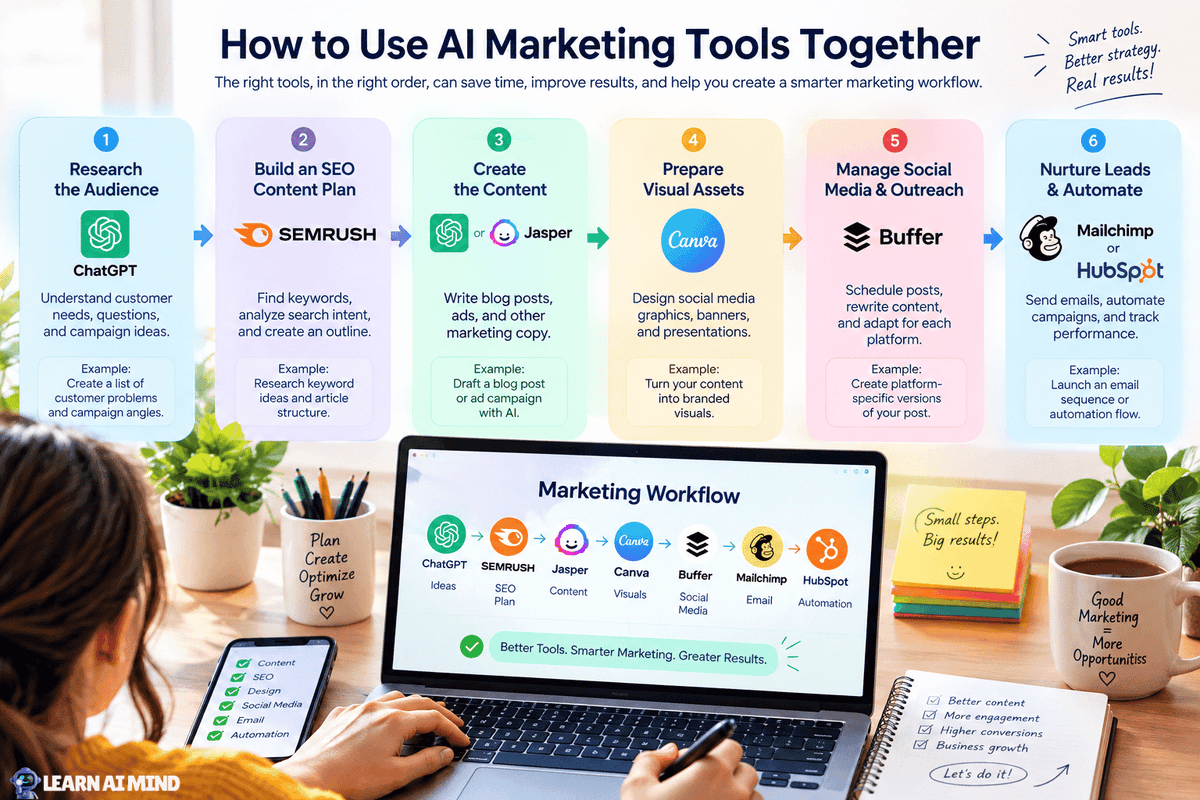
How to Use AI Marketing Tools Together
Buying several AI tools does not automatically create a better marketing strategy. The real benefit comes from connecting each tool to a specific stage of your workflow.
Here is a practical example of promoting a new service:
Step 1: Research the audience. Use ChatGPT to organize customer questions, identify potential objections, and brainstorm campaign angles. Validate important assumptions with customer feedback and reliable research.
Step 2: Build an SEO content plan. Use Semrush to investigate relevant search terms and develop an article outline based on search intent.
Step 3: Create the content. Draft the article and campaign messaging with ChatGPT, or use Jasper if your team needs more structured, brand-focused content workflows.
Step 4: Prepare campaign assets. Use Canva to create supporting visuals and Buffer to adapt the main idea for relevant social platforms.
Step 5: Nurture interested customers. Use Mailchimp for email campaigns, or HubSpot when you need a more connected CRM and marketing automation workflow.
Step 6: Review the results. Measure relevant outcomes, such as qualified leads, email clicks, conversions, and organic traffic. Use those findings to improve the next campaign.
This workflow does not require every business to use all seven tools. Start with the steps that address your biggest bottleneck and add complexity only when it delivers clear value.
How to Choose the Best AI Marketing Tools for Your Business
Before paying for an AI marketing platform, answer four questions.
What problem are you trying to solve? If writing takes too long, start with a content assistant. If your articles struggle to attract organic traffic, prioritize SEO research. If leads are not receiving timely follow-ups, explore automation.
Does the tool fit your existing workflow? A useful tool should reduce friction rather than create another disconnected system.
Can it maintain your brand voice? Review real outputs before committing. Generic, repetitive content can create more editing work instead of saving time.
Can you measure its impact? Track whether the tool helps improve a meaningful outcome, such as time saved, publishing consistency, qualified leads, or conversions.
Start with one primary tool, establish a repeatable process, and measure the results before expanding your stack.
Common Mistakes to Avoid
One mistake is publishing AI-generated content without checking facts, originality, tone, and usefulness. AI can produce convincing language that still contains errors or unsupported claims.
Another is prioritizing content volume over customer value. Publishing ten mediocre posts is not necessarily better than publishing one genuinely useful article.
Finally, be careful with confidential information. Review each provider’s data policies and your organization’s rules before sharing customer records, private business information, or sensitive campaign data.
AI should reduce repetitive work and support better decisions, not replace marketing judgment.
FAQ
What is the best AI tool for marketing?
There is no single best option for every marketer. ChatGPT is a flexible starting point for content and campaign planning, Semrush is useful for SEO workflows, and HubSpot is worth considering when marketing automation and CRM integration are priorities.
Can AI marketing tools help small businesses?
Yes. They can help small businesses create content, prepare social posts, develop campaign ideas, and organize marketing workflows without needing a specialist for every task. Start with tools that address a clear business need and fit your budget.
Can AI tools replace marketing professionals?
No. AI can assist with research, drafting, and repetitive work, but marketers still need to understand customers, develop strategy, verify information, protect brand reputation, and evaluate performance.
Do AI marketing tools improve SEO?
They can support keyword research, content planning, and optimization. However, using AI does not guarantee higher rankings. Results depend on content quality, search intent, competition, technical SEO, and the overall usefulness of the page.
Final Thoughts
The best AI tools for marketing are the ones that help you understand your audience, create more useful content, and make smarter decisions without adding unnecessary complexity.
Start small. Choose a tool that solves a real problem, build it into your workflow, and measure what changes. As your marketing needs grow, you can connect additional tools for SEO, design, social media, email, and automation.
If you want to explore how these technologies can support other areas of a company, continue with our broader guide to AI Tools for Business.