
Seven Technologies That Will Help You Sell Better in 2026 Sales is not just about getting more leads. It is about knowing your customers, reaching out at the right moment, and making it easier for them to decide in favor of purchases.
However, in reality, sales teams spend days and nights conducting research on potential clients, updating their CRM systems, sending emails, and preparing for their meeting, instead of actually selling things.
Here is where sales AI technology comes in.
The most effective sales AI systems are capable of performing mundane tasks, personalizing communication, detecting promising leads, and giving salespersons an opportunity to work on relationship-building. However, not every sales AI tool fits every company.
In this article, we will review seven of the most effective sales AI systems, analyze the benefits of each of them, and learn how to make the best choice for your organization.
What Are AI Tools for Sales?
Sales-related AI tools make use of artificial intelligence in order to provide assistance at the various steps of the sales process. These steps include identifying prospective clients as well as leading the conversations and predicting gains.
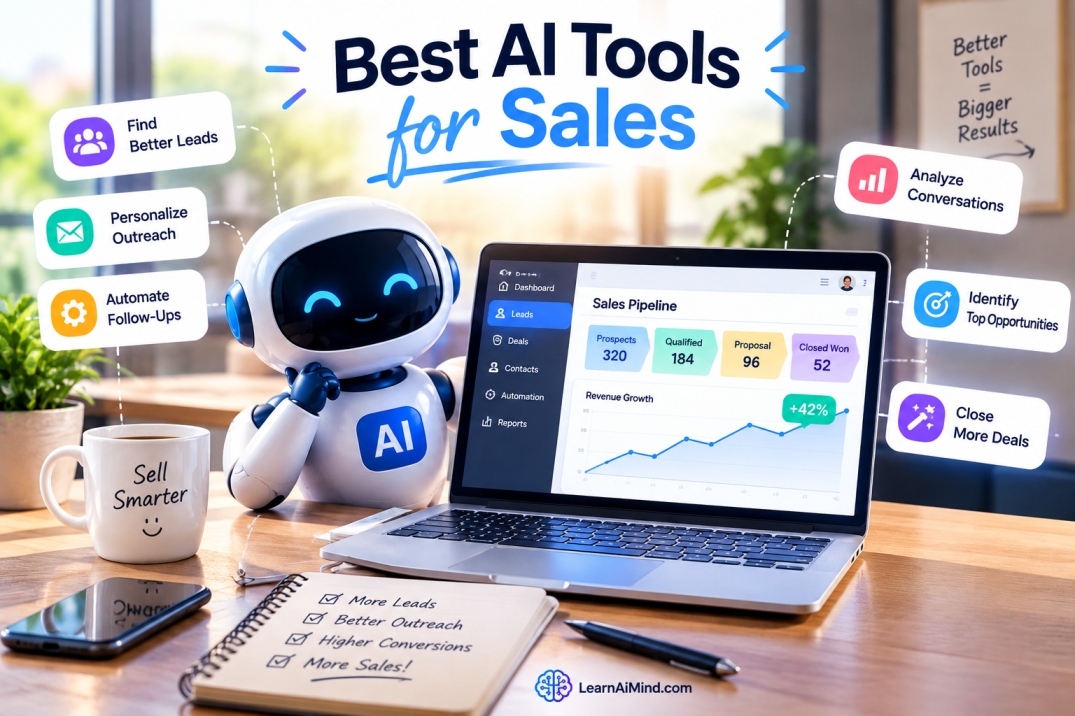
These tools enable sales professionals to do the following:
– Identify and learn more about potential clients.
– Write personalized sales letters.
– Automate mundane follow-up tasks and administrative work.
– Analyze telephone conversations and sales calls.
– Forecast sales opportunities and analyze performance.
In its essence, this tool is not a substitute for sales professionals, but rather its purpose is to minimize the amount of time that is spent on monotonous tasks.
7 Best AI Sales Tools
1.HubSpot Sales Hub – Best for Full Sales Process Oversight
Best for: Looking to get sales tools and customer data in one place for small businesses and growing teams.
HubSpot Sales Hub provides CRM functionality, plus sales automation and AI features, depending on the plan. Sales teams can manage contacts, deals, automate processes, and have tools for prospecting at various levels.
Without a central system, sales reps juggling dozens of prospects may miss follow-up actions, making conversations challenging and potentially losing lucrative leads.
Using HubSpot, these individuals can organize their prospects and know what to say at each stage.
How to use: Start by organizing your sales pipeline and setting up reminders about your prospects. After you get a consistent process, consider which sales tasks could benefit from automation.
Why it’s great: A solid place to start if you need more oversight of the sales process.
2.Salesforce Sales Cloud – Best for Comprehensive Sales Operations
Best for: Medium and large organizations with dozens of sales reps or high-level processes.
Salesforce Sales Cloud is part of a comprehensive CRM featuring sales forecasting, automation, and AI. For companies with vast sales operations, tracking every lead and deal can become unwieldy, and data can become scattered.
With Salesforce, your sales reps can keep all the information about prospects and customers in one place while visualizing the big picture and day-to-day sales processes.
How to use: Take advantage of the data Salesforce provides about your customers and prospects to keep your sales processes accurate and updated.
Why it’s great: Can be a great fit for complex sales operations, though it may require more time and effort to implement and maintain.
3.Apollo.io – Best for Finding Prospects and Leads
Best for: B2B sellers, startups, and others relying on outbound sales to grow their revenue.
Looking for the right prospects may be more challenging than negotiating a deal. Apollo.io features prospecting, email discovery, outreach, and AI to make finding and engaging with prospects easier.
Your reps can find the contacts they want to target without spending hours browsing directories. Instead, they can collect the people they want to engage with based on specific criteria.
How to use: Set up your ideal prospect profile in Apollo. For example, for a growth-focused SaaS company, their ideal prospect is an operations manager at a business of a certain size. Then, use this information to build your outreach list of prospects.
Why it’s great: This tool consolidates prospect discovery and outreach.
Keep in mind that phone numbers, email addresses, and other information may be incomplete or incorrect. Always double-check the data and ensure you are compliant with email marketing regulations.
4.Clay – Best for B2B Outreach With Personalization
Best for: Growth teams and others looking to hyper-target their prospects.
Clay is a tool for sales and growth teams that want to personalize their outreach. It allows users to enrich data about prospects and combine information from multiple sources in one easy-to-use interface.
You may know the value of personalized outreach, but doing it at scale may be time-consuming.
For example, a sales rep may want to share some information about a company’s recent developments with prospects, but this requires separate research for each prospect. Clay can help you identify relevant information to include in your outreach and streamline the process.
How to use: Set up a list of prospects to target and one piece of information you can use to personalize your outreach. When writing the body of your email or LinkedIn message, use this information as a guide to help you stand out from the crowd. Then, review each message to make sure there are no mistakes before sending.
Why it’s great: This tool helps you get beyond the typical “Dear [First Name]” cold outreach emails.
5.Gong – Best for Mining Sales Conversations
Best for: B2B teams, especially in high-tech industries with involved selling processes.
Gong analyzes sales conversations to help teams identify trends and areas of improvement. For teams that have many demos, presentations, and calls with prospects and customers, conversations can be a goldmine of information. However, it can be difficult to recall every detail and use it in future conversations.
A call may seem successful, but a rep may forget some objections or requirements that a prospect mentioned. Conversation intelligence tools can help reps revisit the calls they had to identify what to do next.
How to use: Review the conversations you have with prospects and customers to identify recurring issues. Then, use this information to update your salesplays or prepare talking points for your next conversations.
Why it’s great: With conversation intelligence, you can dig into your everyday sales conversations to improve your processes.
Remember that you may need to comply with recording and privacy regulations when using conversation analytics tools.
6.Outreach – Best for Sales Engagement
Best for: Sales development reps and representatives managing outbound campaigns.
Outreach is a sales engagement platform that helps salespeople and teams organize and prioritize outreach to prospects and customers. Sales development representatives and others using this tool can organize their outreach sequences, set reminders for following up, and track their progress.
When a sales rep misses a call or an email with a prospect, it can be easy to move on and forget about them. A structured sales engagement tool can help you avoid these “dead leads” by keeping track of all your outreach.
How to use: Set up an outreach sequence with engaging emails and follow-up actions. Then, use the engagement tracking functionality to keep following up while providing value to your prospects and customers.
Why it’s great: This tool can help you provide a consistent experience to your prospects without spending hours on each step of the outreach process.
7.Lavender – Best for Cold Emailing and Writing
Best for: Anyone spending a lot of time writing cold emails to prospects.
Lavender is an AI tool to help salespeople improve their cold emails and other outreach messages. If you are spending too much time sending feature lists to prospects without a personal touch, this tool can help you write better, more effective emails.
Long emails or those listing all the features of a product or service can be boring to read. Lavender can help you edit your message to be more personal to the recipient and ensure that it gets through to them.
How to use: Write a short email outlining how you can help the prospect and use the tool’s suggestions to help you finalize the email. Read it again to make sure it sounds natural and conveys the information you want to get across.
Why it’s great: Lavender focuses on one area of sales: emails. You can use this tool to highlight the most relevant parts of your offering and get your value across.
How to Choose an AI Sales Tool
The best AI tools for sales are the ones that solve a particular problem.
Use the following as guidelines to help you focus on the tools that can help you the most:
Do you need more sales organization? Try HubSpot or Salesforce.
- Are you looking to get more sales-qualified prospects? Apollo.io can help.
- Do you need more research and personalization in your outreach? Clay is a good option.
- Would you like to analyze your sales conversations? Consider Gong.
- Are you looking to improve your sales engagement and outreach sequences? Outreach can help.
- Do you need help improving your cold emails? Lavender is a solid choice.
Before you invest in any AI sales tool, take a look at the data, integrations, features, and plan options to see which ones would help your team.
If you are a small business, it may even be worth investing in just one AI sales tool at a time.
How to Get More Value From AI in Sales
Once you invest in an AI sales tool, you need to decide how to use it to get the most value. Here are some pointers to help you get the most value from your purchase:
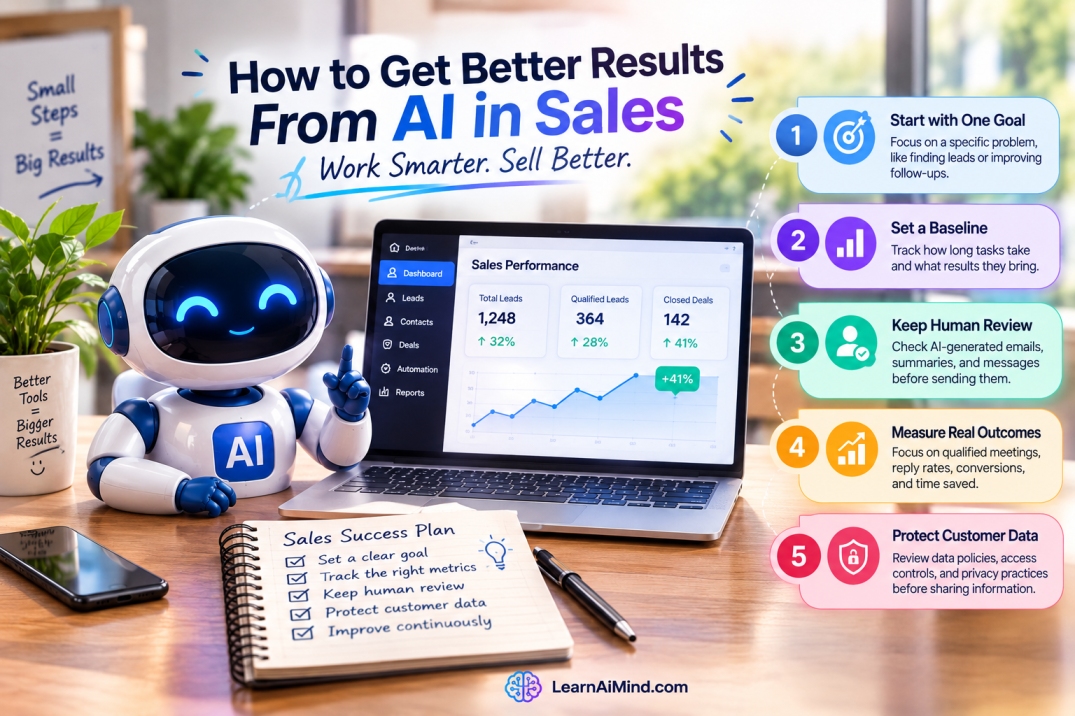
Focus on one particular pain point. Instead of looking at the overall time spent on sales, think of the tasks that consume too much time, such as finding research or updating a CRM.
Establish a baseline. Before you start relying on AI automation, establish how long a task takes you and the results it provides. This will help you see if the tools are providing value.
Keep a human in the loop. Tools such as Lavender may suggest email text, but you should always review it to ensure it makes sense and does not have errors or hallucinations.
Measure your results. Focus on high-level results, such as how many qualified meetings you get or how long a sales cycle takes, instead of the number of tasks you accomplish with AI.
Keep customer data safe. Always double-check the permissions and data practices of tools you use with customer data. Never share sensitive information if there is a risk of compromise.
A good rule of thumb is to automate as much as you can, but keep a human in the loop when it comes to customers.
Final Thoughts
The best AI tools for sales can help you spend less time on administrative tasks and more time on sales and customer success.