What Are AI Agents in Finance?
AI agents in finance are software systems that can perceive information, reason about a task, use financial data and digital tools, and take actions to achieve a defined objective with varying degrees of human supervision.
Unlike traditional automation, which generally follows predefined rules, an AI agent can interpret changing information, decide what steps are required, interact with other systems, and adjust its actions based on the results.
For example, a traditional banking workflow might follow a fixed sequence:
Receive application → check database → apply rules → generate result.
An AI agent could instead:
Receive application → interpret documents → identify missing information → retrieve permitted data → analyze risk → request additional information → prepare a recommendation → escalate exceptions to a human reviewer.
This difference is important because finance contains large volumes of structured and unstructured information, repetitive processes, complex decisions, and strict regulatory requirements.
The Bank for International Settlements has identified AI as potentially transformative across financial intermediation, insurance, asset management, and payments, while also highlighting implications for financial stability and policy.
Why Are AI Agents Important for the Finance Industry?
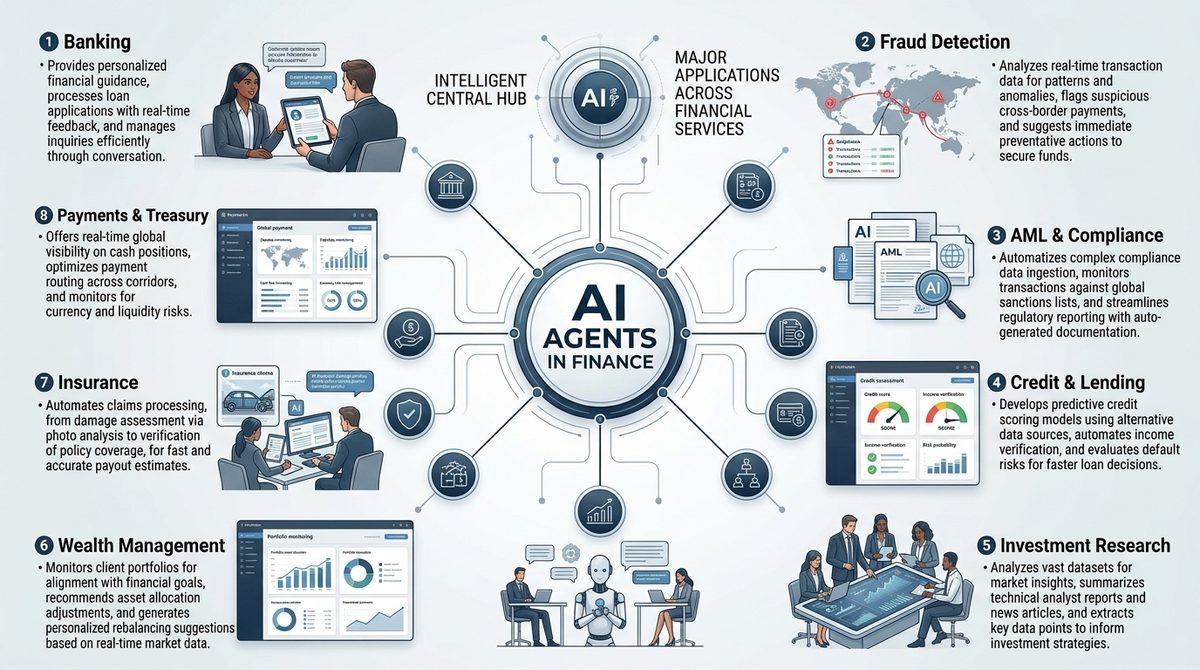
AI agents matter because they can connect reasoning capabilities with business systems and turn AI from a passive assistant into an active workflow participant.
Financial institutions already use artificial intelligence for areas such as fraud detection, credit assessment, customer support, regulatory compliance, claims handling, and market surveillance.
Agentic AI expands the potential scope by allowing AI systems to coordinate multiple steps instead of producing a single prediction or response.
A financial AI agent might:
- Read financial documents
- Extract relevant information
- Compare information across systems
- Detect anomalies
- Generate reports
- Search internal knowledge bases
- Communicate with customers
- Recommend actions
- Trigger approved workflows
- Monitor transactions
- Escalate unusual cases
- Maintain an audit trail
The greatest opportunity is therefore not simply “using AI.”
It is redesigning financial workflows around intelligent, governed agents.
AI Agents in Finance: Quick Overview
| Area | Example AI Agent Task | Potential Benefit | Main Risk |
|---|---|---|---|
| Banking | Analyze loan applications | Faster processing | Bias or incorrect decisions |
| Fraud Detection | Investigate suspicious transactions | Faster detection | False positives |
| Compliance | Review regulatory requirements | Reduced manual workload | Regulatory interpretation errors |
| AML | Investigate transaction patterns | Better case prioritization | Incomplete investigations |
| Customer Service | Resolve routine financial queries | 24/7 support | Incorrect advice |
| Wealth Management | Analyze portfolios and market information | Personalized insights | Unsuitable recommendations |
| Insurance | Process claims and documents | Faster claims handling | Incorrect assessment |
| Payments | Monitor payment flows | Improved operational efficiency | Unauthorized actions |
| Finance Teams | Reconcile and analyze financial data | Reduced manual work | Data-quality errors |
| Investment Research | Summarize filings and market information | Faster research | Hallucinations or stale data |
| Treasury | Monitor liquidity | Faster decision support | Liquidity-management errors |
| Cybersecurity | Investigate suspicious activity | Faster response | Over-automation |
How Do AI Agents Work in Financial Services?
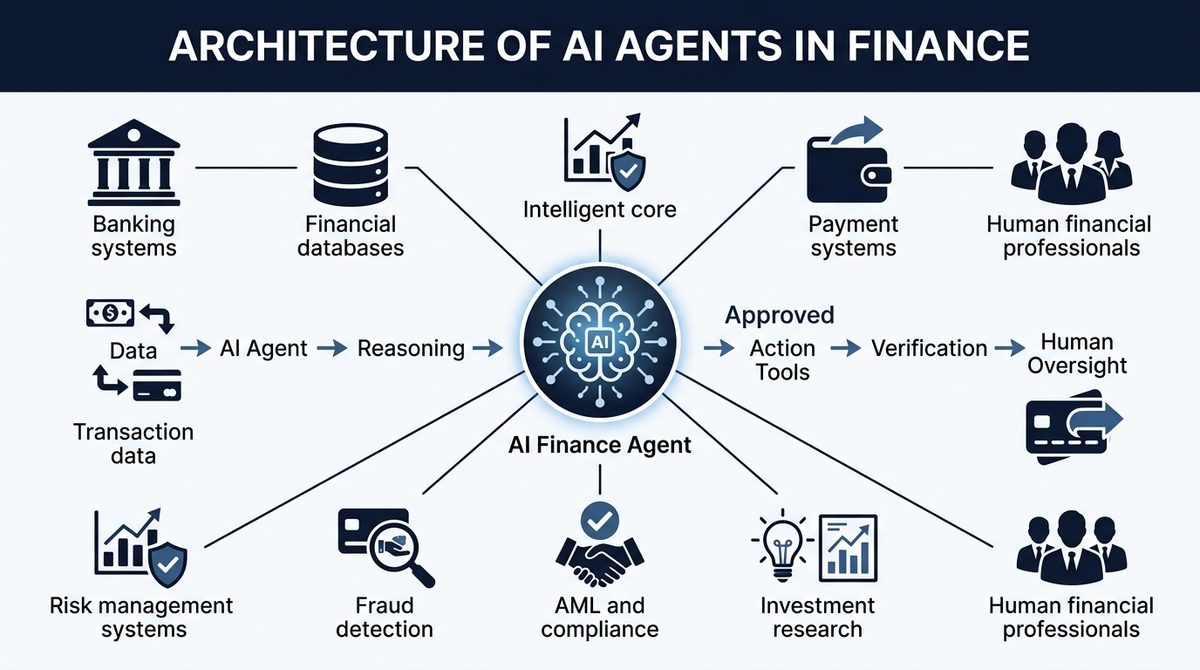
An AI agent typically combines a reasoning model with data, tools, instructions, memory or context, and controls that determine what actions it is allowed to perform.
A simplified architecture looks like this:
User or business event → AI agent → reasoning → data/tools → action → verification → human or system approval
For example, a fraud investigation agent could:
- Receive an alert.
- Retrieve permitted transaction information.
- Compare recent behavior with historical patterns.
- Examine relevant customer or account information.
- Search internal policies.
- Assess whether the case meets escalation criteria.
- Prepare an investigation summary.
- Recommend an action.
- Escalate the case to an authorized employee.
- Record the reasoning, evidence, and decision.
The critical distinction is that the agent should not automatically receive unlimited access.
An effective financial AI agent operates within a clearly defined permission boundary.
That means organizations should establish:
- What data the agent can access
- Which systems it can interact with
- Which actions it can perform
- Which actions require approval
- Maximum transaction or decision limits
- When the agent must escalate
- How actions are logged
- How the agent can be stopped
What Are the Main Use Cases for AI Agents in Finance?
1. AI Agents for Banking
Banking AI agents can automate and coordinate repetitive operational processes while assisting employees with complex financial workflows.
Potential applications include:
- Customer onboarding
- Account servicing
- Loan processing
- Document verification
- Internal research
- Complaint handling
- Financial product support
- Operations management
- Employee assistance
- Back-office processing
An onboarding agent, for example, could review submitted documents, identify missing information, check permitted sources, prepare an application summary, and route exceptions to the appropriate employee.
The goal is not necessarily to eliminate human involvement.
In regulated financial environments, a better model is often human-in-the-loop or human-on-the-loop automation, where AI handles appropriate tasks while people retain responsibility for high-impact decisions.
2. AI Agents for Fraud Detection
AI agents can help financial institutions detect, investigate, prioritize, and document potentially fraudulent activity.
Traditional fraud systems often generate alerts that investigators must manually examine.
An agent can potentially coordinate several investigative steps:
- Analyze transaction history
- Compare behavioral patterns
- Examine related transactions
- Check internal risk signals
- Retrieve relevant policies
- Identify unusual relationships
- Prepare an investigation summary
- Prioritize cases
- Escalate suspicious activity
This can reduce the amount of manual research required per alert.
However, fraud agents should not be treated as infallible investigators. False positives, incomplete information, data-quality problems, adversarial behavior, and model errors can all affect results.
3. AI Agents for Anti-Money Laundering and Compliance
AI agents can assist AML and compliance teams by organizing information, researching policies, summarizing cases, and prioritizing investigative work.
Possible tasks include:
- Transaction monitoring support
- Customer due diligence
- Enhanced due diligence preparation
- Sanctions-screening investigation support
- Regulatory research
- Policy comparison
- Case summarization
- Suspicious activity investigation support
- Compliance documentation
One major advantage is the ability to combine structured transaction information with unstructured documents and regulatory text.
But compliance agents require particularly strong controls.
An agent should not be allowed to invent regulatory requirements or independently interpret ambiguous rules without appropriate review.
4. AI Agents for Credit Risk and Lending
AI agents can support lending workflows by gathering information, analyzing applications, identifying inconsistencies, and preparing decision-support materials.
For example, a lending agent might:
- Review an application.
- Extract information from financial documents.
- Identify missing fields.
- Analyze permitted financial data.
- Compare information against lending policies.
- Flag inconsistencies.
- Produce a risk summary.
- Route the case for human review.
This can make lending operations faster and more consistent.
However, credit decisions can have significant consequences for individuals and businesses. Financial institutions therefore need strong controls around fairness, explainability, data quality, privacy, and regulatory compliance.
The European financial sector is also entering an important period for AI governance. BIS commentary notes that the EU AI Act’s financial-sector implications include areas such as creditworthiness assessment and certain insurance risk and pricing applications.
5. AI Agents for Investment Research
Investment-research agents can help analysts collect, organize, compare, and summarize large quantities of financial information.
A research agent might process:
- Annual reports
- Earnings releases
- Financial statements
- Investor presentations
- Economic reports
- Market data
- Company announcements
- Internal research
- Industry information
Instead of spending hours manually locating information, an analyst could ask an agent to create a structured research package.
The agent might identify revenue changes, compare margins, extract management commentary, summarize risks, and highlight areas requiring further investigation.
The strongest use case is generally decision support rather than unsupervised investment decision-making.
6. AI Agents for Wealth Management
AI agents can help wealth-management organizations deliver more personalized research, portfolio monitoring, client communication, and administrative support.
Examples include:
- Portfolio summaries
- Client meeting preparation
- Market updates
- Investment research
- Risk-profile documentation
- Financial-plan preparation
- Client communication
- Tax-document organization
- Portfolio monitoring
A wealth-management agent could monitor a client’s portfolio and alert an adviser when predefined conditions occur.
However, financial advice requires careful consideration of suitability, client circumstances, regulation, and human accountability.
7. AI Agents for Insurance
Insurance AI agents can coordinate underwriting, claims processing, customer service, document analysis, and fraud investigation.
A claims agent might:
- Read claim documents
- Extract relevant information
- Identify missing evidence
- Compare information against policy terms
- Flag inconsistencies
- Organize supporting documentation
- Prepare a claim summary
- Route complex cases to specialists
The BIS has specifically identified claims handling and personalized financial services among areas where AI can improve financial-service efficiency.
8. AI Agents for Payments and Treasury
AI agents can help monitor liquidity, payment operations, cash positions, exceptions, and operational workflows.
Payment systems are particularly interesting because decisions may need to happen rapidly.
A 2025 BIS working paper examined the use of generative AI agents for cash and liquidity management in real-time gross settlement payment systems.
Potential treasury applications include:
- Liquidity monitoring
- Cash forecasting
- Payment exception handling
- Reconciliation
- Cash-position reporting
- Working-capital analysis
- Payment investigation
- Operational alerts
Because financial transactions can create immediate economic consequences, transaction execution should generally be subject to strict authorization and limit controls.
What Are the Benefits of AI Agents in Finance?
The primary benefits of AI agents in finance are automation, speed, scalability, improved information processing, employee productivity, and more responsive financial operations.
1. Faster workflows
Agents can perform multiple information-processing steps in seconds or minutes.
2. Lower operational workload
Employees can spend less time on repetitive document processing, searching, summarization, and administrative work.
3. Better scalability
An organization can potentially process significantly more cases without increasing manual workload proportionally.
4. Improved employee productivity
Agents can act as digital research and operations assistants.
5. More consistent processes
When properly designed, agents can consistently follow documented procedures and escalation rules.
6. Better access to information
Agents can connect information from multiple approved sources and present it in a structured format.
7. Faster risk detection
AI can continuously monitor information and surface anomalies that require attention.
8. Personalized customer experiences
Financial institutions can potentially use AI to tailor communications and services to individual customers.
The FSB identifies increased operational efficiency, regulatory compliance, product customization, and advanced analytics among AI’s potential financial-sector benefits.
What Are the Risks of AI Agents in Finance?
The main risks include incorrect decisions, hallucinations, cybersecurity threats, privacy violations, model bias, excessive autonomy, poor explainability, third-party concentration, and systemic financial risk.
The risks become more significant as an AI system moves from generating information to taking actions.
Major AI-Agent Risks
| Risk | What It Means | Example |
|---|---|---|
| Hallucination | AI generates incorrect information | Incorrect regulatory interpretation |
| Data Risk | Poor or incomplete data affects decisions | Wrong customer information |
| Bias | Systematic differences affect outcomes | Unequal credit recommendations |
| Cybersecurity | Attackers manipulate systems or agents | Prompt injection |
| Excessive Permissions | Agent can perform too many actions | Unauthorized payment |
| Privacy | Sensitive data is improperly accessed | Exposure of financial information |
| Lack of Explainability | Difficult to understand a decision | Unclear loan recommendation |
| Model Drift | Performance changes over time | Fraud model becomes less accurate |
| Vendor Concentration | Dependence on a small number of providers | Shared technology failure |
| Systemic Risk | Similar AI systems act similarly | Synchronized market selling |
The FSB has warned that AI adoption can create vulnerabilities through cyber risks, third-party dependencies, data issues, model risk, and increased interconnectedness.
BIS research also highlights the possibility that widespread use of similar AI systems could contribute to synchronized behavior, increased volatility, liquidity pressures, and other financial-stability risks.
How Should Financial Institutions Govern AI Agents?
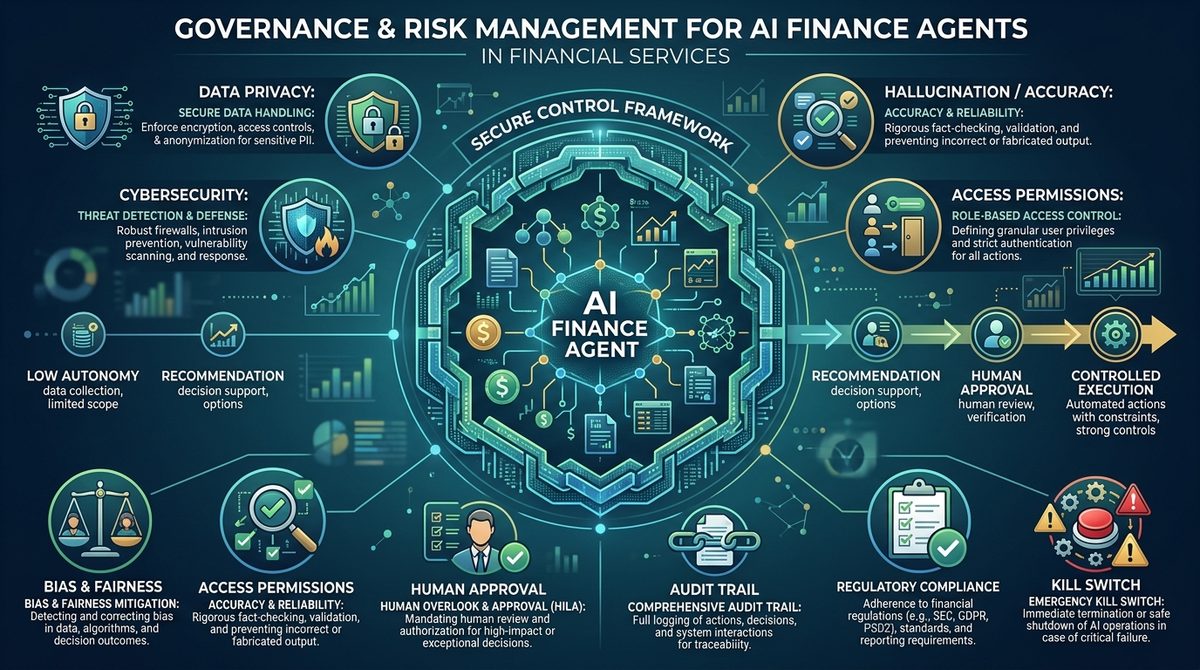
Financial institutions should govern AI agents according to their level of autonomy, access to data, ability to affect customers, and ability to execute consequential actions.
A practical governance framework should include:
1. Agent inventory
Organizations should know which AI agents exist, where they operate, what models they use, and what systems they can access.
2. Defined ownership
Every agent should have an accountable business and technical owner.
3. Permission controls
Agents should receive only the minimum access required to perform their assigned tasks.
4. Autonomy tiers
A useful framework is:
| Tier | Agent Capability | Example |
|---|---|---|
| 0 | Information only | Answer internal questions |
| 1 | Recommend | Suggest a fraud-investigation action |
| 2 | Prepare | Draft a payment but do not execute |
| 3 | Execute with approval | Submit transaction after human approval |
| 4 | Limited autonomous execution | Execute within strict predefined limits |
| 5 | High autonomy | Complex independent workflow |
The higher the autonomy, the stronger the controls should be.
5. Auditability
Organizations should maintain records showing:
- What the agent received
- Which tools it used
- Which information influenced the action
- What it recommended
- What action was taken
- Who approved the action
- When the action occurred
6. Human escalation
Agents need explicit escalation criteria.
For example:
If confidence is below a defined threshold → escalate.
If the transaction exceeds a defined limit → require approval.
If policy interpretation is ambiguous → escalate.
If data is missing or contradictory → stop and request review.
7. Kill switches
High-impact agents should have mechanisms that allow authorized personnel to immediately suspend their operation.
What Framework Can Be Used for AI Risk Management?
The NIST AI Risk Management Framework is a useful general-purpose reference for organizations developing AI governance processes.
NIST’s AI RMF is designed to help organizations manage AI risks and promote trustworthy AI. Its core framework focuses on functions including Govern, Map, Measure, and Manage.
NIST also published a Generative AI Profile that addresses risks associated with generative AI across its lifecycle. The profile was updated in April 2026.
For financial institutions, however, AI governance should not exist in isolation.
It should connect with existing:
- Operational risk management
- Model risk management
- Cybersecurity
- Data governance
- Privacy
- Compliance
- Internal audit
- Business continuity
- Third-party risk management
- Consumer protection
The objective is not simply to create an “AI policy.”
The objective is to create a controlled operating model for AI.
AI Agents vs Traditional Automation: What’s the Difference?
Traditional automation generally follows predefined rules, while AI agents can interpret information, reason about tasks, use tools, and adapt their workflow within defined boundaries.
| Characteristic | Traditional Automation | AI Agent |
|---|---|---|
| Logic | Predefined rules | Model-assisted reasoning |
| Inputs | Usually structured | Structured + unstructured |
| Workflow | Fixed | Potentially dynamic |
| Adaptability | Limited | Higher |
| Tool use | Preconfigured | Can select from permitted tools |
| Decision-making | Rule-based | Context-dependent |
| Autonomy | Usually low | Can range from low to high |
| Governance | Workflow controls | Workflow + model + agent controls |
The important point is that AI agents do not replace conventional automation.
In many financial systems, the best architecture will combine both.
For example:
AI agent = interpretation and coordination
Traditional software = deterministic execution
Policy engine = compliance constraints
Human reviewer = accountability for high-impact decisions
This hybrid architecture can be safer and easier to audit than allowing a general-purpose AI system to directly control critical financial infrastructure.
What Does the Future of AI Agents in Finance Look Like?
The future is likely to involve increasingly specialized, interconnected, and governed AI agents rather than a single AI system controlling an entire financial institution.
Possible future architectures include:
Multi-agent financial systems
One agent could specialize in customer service, another in compliance, another in risk analysis, and another in operations.
AI-powered financial operations
Agents could continuously monitor workflows and resolve routine exceptions.
AI-native banking
Banks may increasingly design products and processes around AI-assisted interactions from the beginning rather than adding AI to legacy workflows.
Agent-to-agent financial interactions
In more advanced environments, software agents could negotiate, request information, validate transactions, or coordinate processes with other authorized agents.
Continuous financial monitoring
Instead of periodic reporting, organizations could move toward continuous analysis of risk, liquidity, compliance, and operational performance.
But increased autonomy also increases the importance of resilience.
The IMF has emphasized the need for stronger oversight and governance of AI-driven trading, lending, and supervisory technology, together with better visibility into AI dependencies and stronger international coordination around cyber and operational resilience.
Are AI Agents Safe for Financial Institutions?
AI agents can be used safely in finance when their capabilities, permissions, data access, monitoring, and escalation paths are carefully controlled.
The question should not be:
“Is AI safe?”
A better question is:
“Is this particular AI agent safe for this particular financial task under these specific controls?”
An AI agent summarizing an internal report presents a very different risk profile from an agent authorized to execute a large payment.
Risk should therefore be assessed according to:
Impact × Autonomy × Access × Uncertainty
High-impact tasks with high autonomy, broad access, and significant uncertainty require the strongest controls.
How Can a Company Start Using AI Agents in Finance?
The safest starting point is a narrowly defined, high-volume, low-risk workflow with measurable outcomes and limited system permissions.
A practical implementation roadmap is:
Step 1: Identify the workflow
Find a repetitive process with clear inputs and outputs.
Step 2: Define the business objective
For example:
- Reduce processing time
- Improve employee productivity
- Reduce manual research
- Increase investigation capacity
Step 3: Classify the risk
Determine whether the agent can affect:
- Money
- Customers
- Credit
- Investments
- Compliance
- Personal data
- Critical infrastructure
Step 4: Establish permissions
Give the agent only the access required.
Step 5: Create evaluation tests
Test:
- Accuracy
- Reliability
- Security
- Bias
- Data leakage
- Tool misuse
- Prompt injection
- Escalation behavior
Step 6: Start with human approval
Use human review before enabling autonomous actions.
Step 7: Monitor performance
Track both successful and unsuccessful outcomes.
Step 8: Expand autonomy gradually
Move from:
Read → Recommend → Prepare → Execute with approval → Limited autonomy
rather than immediately giving an agent unrestricted authority.
What Skills Will Finance Professionals Need in the Age of AI Agents?
Finance professionals will increasingly need a combination of financial expertise, AI literacy, data skills, risk management, and the ability to supervise AI-driven workflows.
Important skills include:
- AI fundamentals
- Prompt and workflow design
- Financial analysis
- Data interpretation
- AI governance
- Risk management
- Cybersecurity awareness
- Regulatory understanding
- Model evaluation
- Human-AI collaboration
- Process redesign
- Critical thinking
The value of human professionals will not disappear simply because agents become more capable.
Instead, the nature of the work is likely to change.
Professionals may spend less time collecting and formatting information and more time:
- Defining objectives
- Evaluating evidence
- Managing exceptions
- Making judgment-based decisions
- Designing controls
- Supervising AI systems
- Communicating with stakeholders
AI Agents in Finance: Key Takeaways
AI agents represent the next stage of financial automation by combining AI reasoning with tools, data, workflows, and controlled actions.
The biggest opportunities are in:
- Banking operations
- Fraud detection
- AML and compliance
- Credit workflows
- Investment research
- Wealth management
- Insurance
- Payments
- Treasury
- Finance operations
- Customer service
The biggest risks are:
- Incorrect outputs
- Hallucinations
- Bias
- Data leakage
- Cyberattacks
- Excessive permissions
- Poor auditability
- Third-party concentration
- Synchronized AI behavior
- Systemic financial risk
The central lesson is simple:
The future of AI in finance will depend as much on governance as on intelligence.
Financial institutions that build powerful agents without adequate controls may create new operational and systemic risks. Institutions that combine capable AI with strong permissions, monitoring, auditability, human oversight, and resilience can potentially gain substantial productivity and service advantages.
The FSB has called for financial authorities to improve their ability to monitor AI adoption and risks, while BIS research similarly emphasizes both the benefits and financial-stability implications of increasingly capable AI.
FAQ
What is an AI agent in finance?
An AI agent in finance is an AI-powered software system that can interpret information, reason about a financial task, use authorized tools or data, and perform or recommend actions within defined controls.
How are AI agents used in banking?
AI agents can support banking operations such as customer service, onboarding, loan processing, fraud investigation, compliance, document analysis, research, and back-office operations.
What is agentic AI in finance?
Agentic AI refers to AI systems designed to pursue objectives through multiple steps, potentially using tools and taking actions rather than simply generating a single response.
Can AI agents make financial decisions?
Yes, AI agents can support or make certain decisions depending on their design and authorization, but high-impact financial decisions generally require appropriate governance, controls, and human oversight.
What are the biggest risks of AI agents in finance?
The biggest risks include inaccurate outputs, bias, cybersecurity attacks, privacy problems, excessive autonomy, poor explainability, model failures, third-party dependencies, and systemic financial risks.
Can AI agents detect financial fraud?
Yes. AI agents can assist with fraud detection by analyzing transaction patterns, investigating alerts, retrieving relevant information, and prioritizing cases for human investigators.
Can AI agents help with AML compliance?
Yes. AI agents can assist with transaction monitoring, case investigation, regulatory research, customer due diligence, sanctions-screening investigations, and compliance documentation.
Are AI agents replacing finance professionals?
AI agents are more likely to automate portions of finance jobs than eliminate the need for financial professionals entirely. Human expertise remains important for judgment, accountability, governance, relationship management, and complex decisions.
How do AI agents differ from chatbots?
A chatbot primarily communicates with users, while an AI agent can potentially plan and execute multi-step tasks using authorized tools and systems.
How should banks govern AI agents?
Banks should establish agent inventories, ownership, access controls, autonomy limits, monitoring, testing, audit logs, escalation procedures, security controls, and mechanisms for rapidly suspending agents.
Is AI agent technology regulated in finance?
AI agents may be subject to existing financial, privacy, cybersecurity, consumer-protection, and AI-specific requirements depending on the jurisdiction and use case. Organizations should assess each deployment against applicable laws and regulatory expectations.
What is the best first AI-agent use case for a financial institution?
A good starting point is usually a repetitive, measurable, low-risk workflow where the agent can operate with limited permissions and human review.
What is the future of AI agents in finance?
The future is likely to involve specialized agents working alongside conventional software and human professionals, with increasing automation of research, operations, monitoring, and decision-support workflows.