
Artificial Intelligence (AI) is one of the most exciting fields in technology today, but if you’re just starting out, the terms AI, Machine Learning (ML), and Deep Learning (DL) can feel confusing. You might hear people use them interchangeably, but they’re actually different layers of the same concept.
In this beginner-friendly guide from Learnaimind, we’ll break it down with simple explanations, examples, and practical applications so you can understand the differences clearly.
1. What is Artificial Intelligence (AI)?
At its core, Artificial Intelligence is the ability of machines to perform tasks that normally require human intelligence.
Think of AI as the umbrella term that covers everything from a program that recommends movies on Netflix to self-driving cars.
Practical Examples:
- Smart assistants like Siri, Alexa, or Google Assistant
- Recommendation systems on YouTube, Spotify, or Amazon
- AI in healthcare that analyzes medical images
Key Point: AI is the big picture. It’s about machines doing intelligent things — not necessarily how they learn to do it.
2. What is Machine Learning (ML)?
Machine Learning is a subset of AI. It’s the method by which machines learn from data instead of being explicitly programmed.
Instead of giving the computer step-by-step instructions, you give it lots of examples, and it figures out patterns or makes predictions.
Practical Examples:
- Spam filters in your email
- Predicting stock prices or weather
- Recognizing handwriting or images
How it Works (Simplified):
- Collect Data – For example, pictures of cats and dogs.
- Train the Model – The computer learns patterns from these pictures.
- Make Predictions – Give it a new picture, and it predicts whether it’s a cat or dog.
Key Point: ML is about learning from data, whereas AI is the broader goal of making machines intelligent.
3. What is Deep Learning (DL)?
Deep Learning is a subset of Machine Learning. It uses something called neural networks — algorithms inspired by the human brain — to learn from huge amounts of data.
DL is best for complex tasks that require analyzing patterns in unstructured data like images, audio, and video.
Practical Examples:
- Face recognition in photos
- Voice assistants understanding natural language
- Self-driving cars detecting objects on the road
How it Works (Simplified):
- Imagine multiple layers of “neurons” processing information.
- Each layer extracts features from the data, learning increasingly complex patterns.
- The model improves automatically as it processes more data.
Key Point: Deep Learning is like a specialized, super-powered ML, best for tasks where patterns are too complicated for traditional ML algorithms.
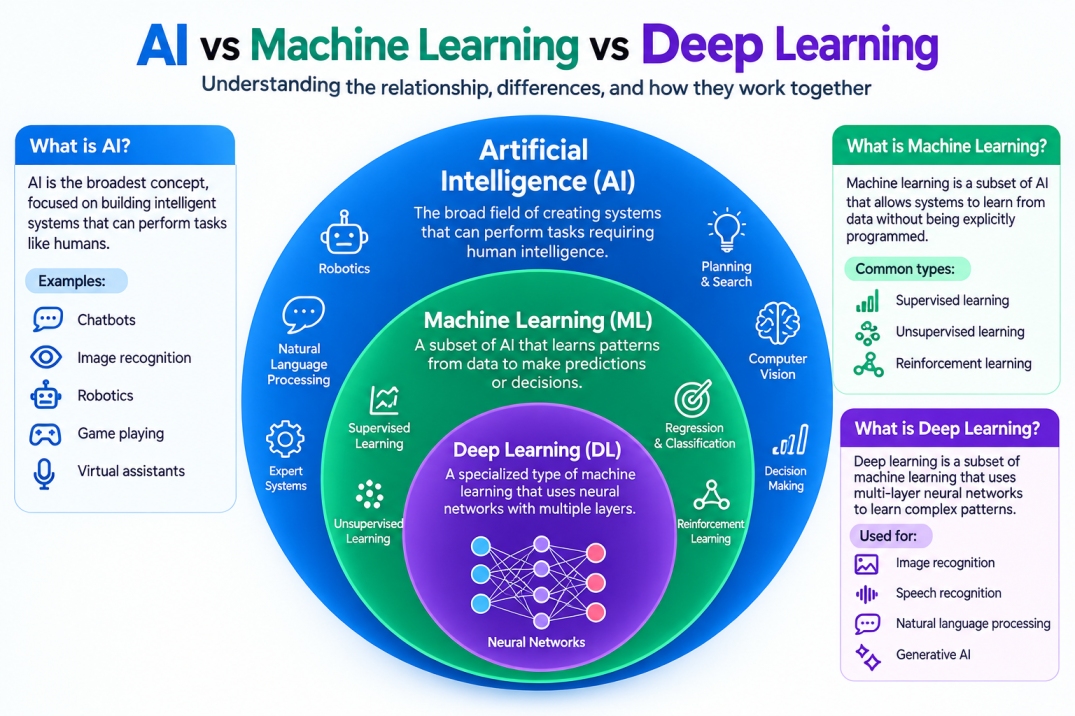
4. AI vs ML vs DL: The Key Differences
| Feature | Artificial Intelligence | Machine Learning | Deep Learning |
|---|---|---|---|
| Definition | Broad field of intelligent computer systems | Subset of AI that learns from data | Subset of ML using deep neural networks |
| Main approach | Rules, logic, ML, neural networks, and other techniques | Statistical and algorithmic learning | Multi-layer neural networks |
| Data requirements | Varies widely | Usually requires meaningful amounts of data | Often requires very large datasets |
| Human involvement | Can require extensive rules | Humans often select useful features | Can automatically learn many useful features |
| Computing requirements | Varies | Moderate to high | Often high |
| Best for | Broad intelligent tasks | Prediction and pattern recognition | Complex data such as images, speech, and language |
| Examples | Expert systems, virtual assistants, autonomous systems | Spam filtering, recommendation models, forecasting | Speech recognition, modern computer vision, generative AI |
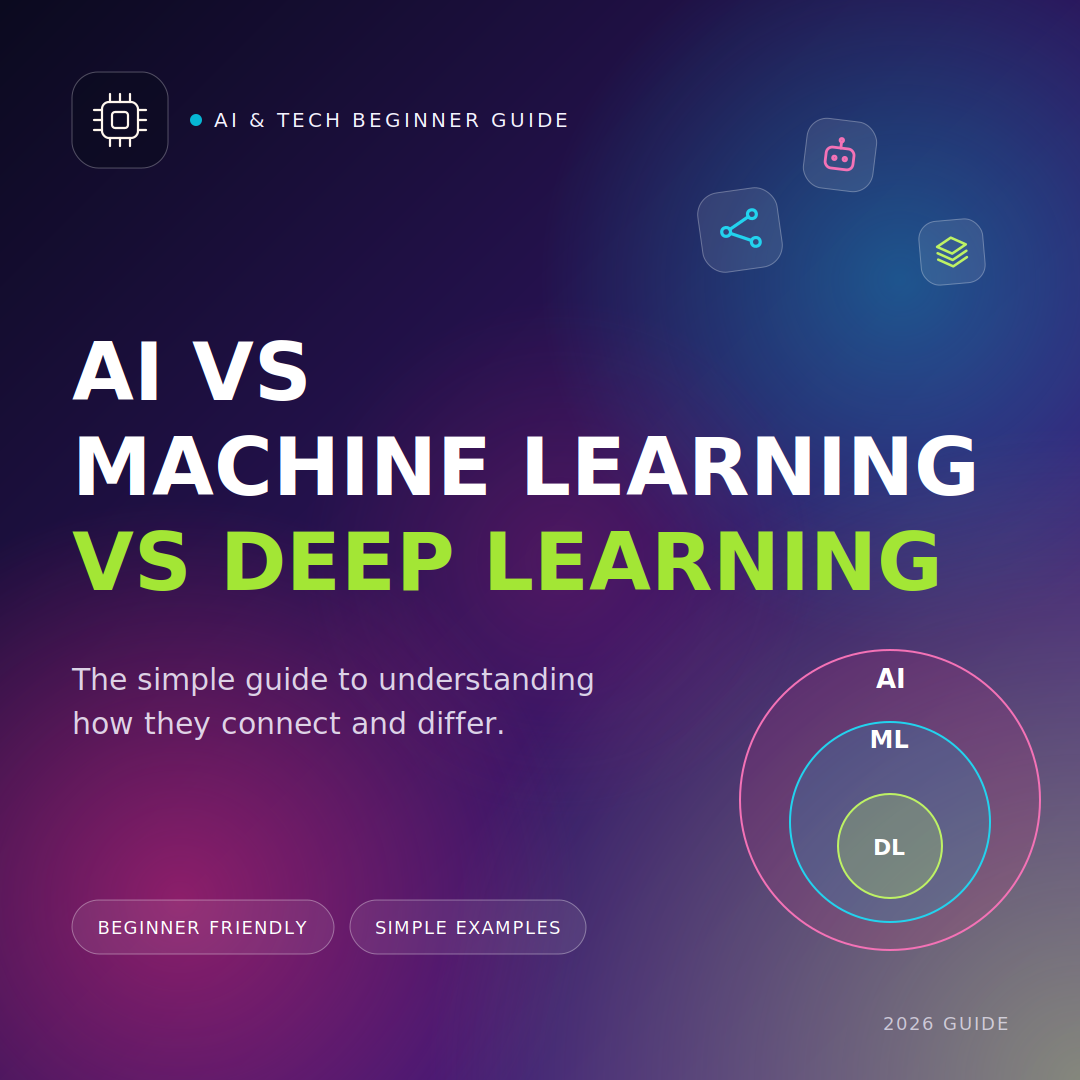
The most important distinction is scope.
Tip: Think of it like this:
AI = The big goal → make machines intelligent
ML = One way to achieve AI → machines learn from data
DL = A powerful technique within ML → uses neural networks for complex tasks
Real-World Examples of AI, Machine Learning, and Deep Learning
Understanding practical examples can make the differences much clearer.
Chatbots and Generative AI
Modern conversational AI systems use sophisticated machine learning and deep learning techniques.
Large neural networks can be trained on huge collections of data to learn relationships within language.
The broader application falls under AI.
The underlying learning methods involve machine learning, while modern large-scale language systems heavily depend on deep learning.
Netflix and Streaming Recommendations
A recommendation system can analyze viewing behavior to predict which movies or shows a user may enjoy.
Machine learning can identify patterns across users and content.
This is an example of AI powered by machine learning.
Email Spam Filtering
Spam detection can analyze characteristics of messages and classify them as spam or legitimate.
Machine learning algorithms can learn these patterns from previously labeled emails.
This is a classic machine learning application.
Facial Recognition
Facial recognition systems use computer vision techniques to analyze images and identify patterns associated with faces.
Many modern high-performance vision systems rely on deep neural networks.
Voice Assistants
Systems that recognize speech, interpret language, and generate responses combine several AI technologies.
Deep learning is commonly used for speech recognition and language processing, while broader AI components coordinate the overall experience.
Self-Driving Vehicles
Autonomous driving systems involve multiple technologies working together, including:
- Computer vision
- Sensor processing
- Prediction
- Planning
- Control systems
- Machine learning
- Deep learning
This illustrates an important point: real-world AI systems often combine multiple technologies rather than relying on a single algorithm.
5. Why This Matters for Beginners
Understanding the difference between AI, ML, and DL is practical and useful:
- Helps you choose the right tools and learning path.
- Avoids confusion when reading articles, taking courses, or attending workshops.
- Gives you context for real-world applications and career opportunities in AI.
Practical Tip from Learnaimind:
Start learning AI with high-level concepts first. Once comfortable, try ML projects with small datasets, then explore DL projects when you’re ready to handle larger data and more complex problems.
6. Quick Practical Example You Can Try Today
Let’s make it tangible:
- Go to Google Teachable Machine (free online tool).
- Upload a few images of two objects (like apples and oranges).
- Train a model.
- Test it with new images.
This simple exercise shows AI in action (model predicting objects), ML at work (learning patterns), and even a tiny taste of DL concepts if the tool uses neural networks behind the scenes.
The Relationship Between AI, ML, and DL
The relationship can be summarized in one diagram:
Artificial Intelligence (AI)
│
├── Rule-Based Systems
├── Search & Planning
├── Expert Systems
└── Machine Learning (ML)
    │
    ├── Supervised Learning
    ├── Unsupervised Learning
    ├── Reinforcement Learning
    └── Deep Learning (DL)
        │
        ├── Neural Networks
        ├── Computer Vision
        ├── Speech Recognition
        ├── Natural Language Processing
        └── Generative AI
This hierarchy is one of the easiest ways to remember the difference.
Every deep learning system is machine learning.
Every machine learning system is part of AI.
But not every AI system uses machine learning, and not every machine learning system uses deep learning.
Conclusion
To sum up:
- AI is the broad goal — making machines smart
- ML is a way to achieve AI by learning from data
- DL is a powerful ML technique using neural networks for complex data
At Learnaimind, we believe that anyone can learn these concepts with the right guidance and practice. Start exploring, experiment with small projects, and step by step, you’ll understand the amazing world of AI.