
Claude (by Anthropic), ChatGPT (by OpenAI), and Gemini (by Google) are the three leading AI assistants in 2026, and each has a different strength. Claude is generally favored for writing quality, careful reasoning, and long-document work. ChatGPT leads in agentic tasks, coding automation (via Codex), and ecosystem breadth. Gemini stands out for deep integration with Google Workspace, search-grounded answers, and multimodal tasks like image and video understanding. There is no single “best” model — the right choice depends on what you’re using it for.
This guide breaks down how these three AI assistants actually differ in 2026, where each one wins, what they cost, and how to decide which one fits your specific needs — whether that’s writing, coding, research, business use, or everyday tasks.
What Are Claude, ChatGPT, and Gemini?
All three are AI chat assistants built on large language models, but they come from different companies with different design philosophies:
- Claude is developed by Anthropic, a company that has placed a strong public emphasis on AI safety and reliability. Claude’s current lineup includes Claude Haiku 4.5 (fast, lightweight), Claude Sonnet 5 (balanced everyday model), and Claude Opus 4.8 (top-tier reasoning), alongside the newer Mythos-tier models, Claude Fable 5 and Claude Mythos 5.
- ChatGPT is developed by OpenAI and built on the GPT model family. As of mid-to-late 2026, the flagship lineup is GPT-5.6, split into three tiers: Sol (highest capability, strong at coding and agentic work), Terra (balanced everyday use), and Luna (fast, lower-cost, available to free users).
- Gemini is developed by Google DeepMind and integrates tightly with Google’s ecosystem (Search, Workspace, Android). Its current lineup includes Gemini 3.1 Pro (top reasoning tier), Gemini 3 Deep Think (extended reasoning mode), and the Flash family (3.5/3.6/3.7 Flash) for faster, cheaper tasks.
Each company also ships smaller, faster models alongside its flagship, so “which model” often matters as much as “which company” when comparing real-world performance.
Head-to-Head Comparison Table
| Category | Claude (Anthropic) | ChatGPT (OpenAI) | Gemini (Google) |
|---|---|---|---|
| Flagship models | Opus 4.8, Sonnet 5, Haiku 4.5; Fable 5 / Mythos 5 (Mythos tier) | GPT-5.6 Sol, Terra, Luna | Gemini 3.1 Pro, 3 Deep Think, 3.5–3.7 Flash |
| Strongest at | Long-form writing, nuanced reasoning, document analysis, careful/cautious output | Agentic workflows, coding automation (Codex), broad plugin/tool ecosystem | Search-grounded answers, multimodal (image/video), Workspace integration |
| Context window | Large (varies by model; strong for long documents) | Large (400K+ tokens on recent models) | Large, with strong multimodal context handling |
| Coding ability | Strong, especially for careful, well-reasoned code | Very strong, especially agentic/autonomous coding via Codex | Strong, tightly integrated with Google Cloud and Android tooling |
| Multimodal support | Text, images, documents | Text, images, voice, some video via tools | Text, images, video, audio — generally the most multimodal-native |
| Free tier available | Yes, limited usage | Yes, limited to a smaller model (e.g., GPT-5.6 Luna) | Yes, integrated into Google Search and Gemini app |
| Ecosystem integration | Claude Code, Claude for Excel/PowerPoint/Chrome, API/Claude Platform | ChatGPT Work, Codex, broad third-party plugin support | Google Workspace (Docs, Chat, Gmail), Android, Search |
| Best for | Writers, researchers, analysts, teams needing careful/trustworthy output | Developers, agentic automation, power users wanting an all-in-one tool | Google Workspace users, multimodal tasks, search-heavy workflows |
Model names and capabilities are current as of August 2026 and change frequently as each company ships updates — always check the provider’s official release notes for the latest details.
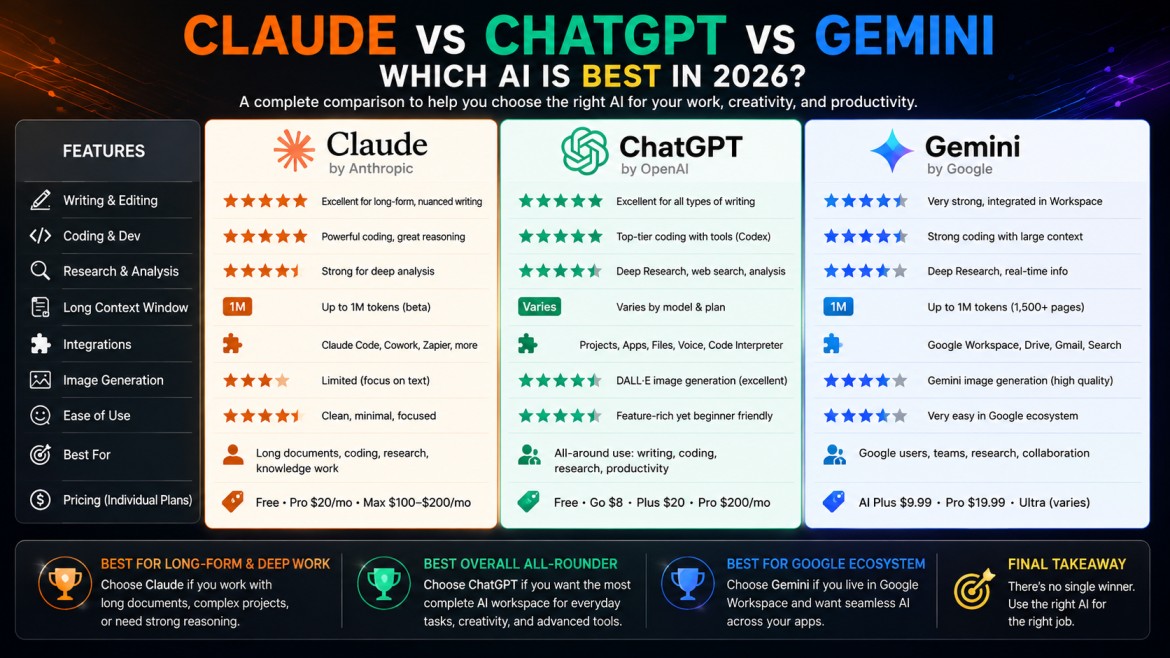
Claude vs ChatGPT vs Gemini Pricing
Pricing changes frequently, and regional taxes, currencies, promotions, and availability can differ.
At the time of this comparison, some major consumer plans include:
| Platform | Key individual plans | Current US reference pricing |
| ChatGPT | Free, Go, Plus, Pro | Go $8; Plus $20; Pro $200 |
| Claude | Free, Pro, Max 5x, Max 20x | Pro $20; Max $100/$200 |
| Gemini | Google AI Plus, Pro, Ultra | Plus $9.99; Pro $19.99; Ultra pricing varies by current offer/market |
OpenAI currently lists ChatGPT Go at $8/month in the United States, Plus at $20/month, and Pro at $200/month.
Anthropic currently lists Claude Pro at $20/month, with Max 5x at $100/month and Max 20x at $200/month.
Google currently lists Google AI Plus at $9.99/month and Google AI Pro at $19.99/month on its US-facing Google One pricing pages.
The price comparison therefore isn’t simply “which chatbot is cheapest?”
You should also compare what else is included.
For example, Google AI Pro combines Gemini access with storage and Google ecosystem benefits. ChatGPT Plus focuses more directly on access to advanced AI models and tools. Claude Pro includes Claude Code and Cowork access.
Which AI Is Best for Students?
For students, all three can be useful for:
- explaining difficult concepts
- summarizing research papers
- generating study questions
- creating flashcards
- debugging code
- translating difficult material
- creating study plans
- analyzing documents
Best overall: ChatGPT
ChatGPT’s combination of tutoring, multimodal capabilities, files, voice, data analysis, and broad functionality makes it a strong all-around student assistant.
Best for large academic documents: Claude or Gemini
Claude is attractive for long-form document analysis, while Gemini’s 1M-token context on eligible plans can be particularly useful for very large collections of text.
Important warning for students
The best use of AI is not to outsource learning.
Use AI to explain concepts, challenge your understanding, generate practice questions, and provide feedback.
The goal should be:
AI-assisted learning, not AI-replaced learning.
Can You Use Claude, ChatGPT, and Gemini Together?
Absolutely.
In fact, advanced users may get better results by treating them as complementary systems rather than competitors.
For example:
ChatGPT → strategy
Use ChatGPT to brainstorm the structure of a project.
Claude → refinement
Use Claude to critique, rewrite, or expand the long-form material.
Gemini → Google workflow
Move the research and final assets into Docs, Gmail, Drive, or other Google services.
Another workflow might involve asking two models the same difficult question and then comparing their answers.
This is often more useful than trying to identify one permanent “best AI.”
FAQ
Is Claude better than ChatGPT?
Not universally.
Claude can be particularly strong for long-form writing, coding, long-context reasoning, and agentic workflows. ChatGPT offers a broader general-purpose ecosystem with reasoning models, research, image generation, files, data analysis, voice, and other tools.
Is ChatGPT better than Gemini?
For many general-purpose users, ChatGPT is the more flexible standalone AI workspace.
However, Gemini can be the better choice for people heavily invested in Google Workspace and Google’s broader AI ecosystem. Google currently integrates Gemini into Gmail, Docs, Vids, NotebookLM, and other products.
Is Gemini better than Claude?
It depends on the task.
Gemini has a major advantage in the Google ecosystem and supports a 1M-token context window on eligible Pro and Ultra plans. Claude is particularly competitive in coding, long-form knowledge work, and agentic workflows.
Which is best for SEO content?
All three can produce high-quality SEO content.
For large content workflows, ChatGPT is particularly convenient because it can combine research, writing, data analysis, content planning, and other tools.
Claude is excellent for editorial refinement and long-form prose.
Gemini is useful when content research and organization happen heavily inside Google’s ecosystem.
Which is best for coding?
There is no universal winner.
Claude has become particularly strong in agentic software development through Claude Code. ChatGPT combines coding with a broad tool ecosystem and Codex. Gemini is also strong for developers and benefits from its very large context window on eligible plans.
Which has the biggest context window?
Claude and Gemini currently advertise up to 1 million tokens for certain models or plans. The exact availability and behavior depend on the product surface.
Which AI is best for research?
ChatGPT, Claude, and Gemini all have strong research capabilities.
ChatGPT is particularly strong for broad research workflows and tool use.
Claude is excellent for analyzing large bodies of source material.
Gemini is particularly attractive for Google Search and Google ecosystem workflows.
Which AI is best for beginners?
For most beginners, ChatGPT is the easiest overall recommendation because it combines a simple interface with a very broad range of capabilities.
However, beginners who live in Google Workspace may find Gemini more natural.
Do I need all three?
No.
For most people, one primary AI system is enough.If your work is heavily dependent on AI, using two or three strategically can make sense because each platform has different strengths.
Learn How to Turn AI Into a Practical Income Tool
Knowing how to use ChatGPT, Claude, or Gemini is useful.
Knowing how to turn those tools into real workflows, services, content systems, and income opportunities is much more valuable.
We’ve created a practical ebook designed to help readers go beyond simply experimenting with AI and start building useful AI-powered income streams.