
Artificial intelligence is transforming digital marketing from a largely manual discipline into a data-driven, increasingly automated system for attracting, engaging, converting, and retaining customers.
AI digital marketing uses artificial intelligence technologies to analyze customer data, identify patterns, generate and optimize content, personalize campaigns, automate repetitive tasks, improve advertising performance, and support faster marketing decisions.
The biggest opportunity is not simply using AI to produce more content. It is using AI to make better decisions at every stage of the customer journey.
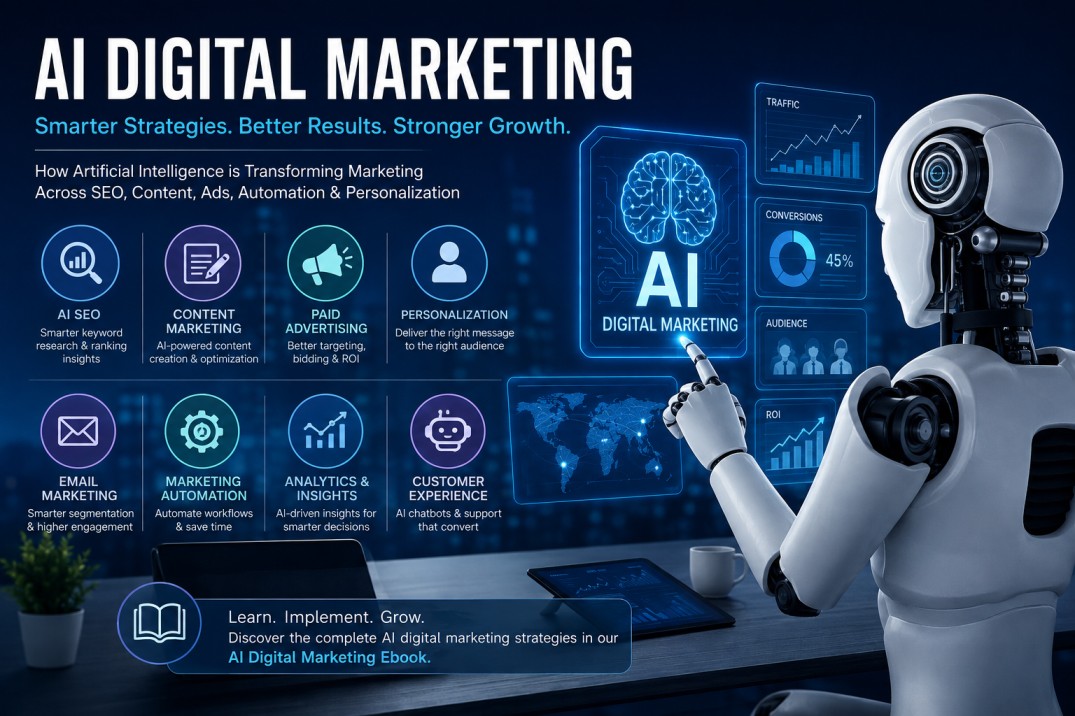
Businesses can use AI to understand search intent, create content briefs, segment audiences, improve ad targeting, predict customer behavior, automate workflows, analyze campaign performance, and provide personalized experiences at scale.
This guide explains what AI digital marketing means, how it works, where it creates the most value, what its limitations are, and how businesses can build an effective AI-powered marketing strategy.
Looking for a practical resource? Explore the AI Digital Marketing Ebook for a deeper framework, strategies, and actionable techniques you can apply to your marketing workflow.
What Is AI in Digital Marketing?
AI in digital marketing refers to the use of machine learning, natural language processing, and predictive algorithms to automate, optimize, and personalize marketing activities. Instead of manually managing every campaign decision, marketers use AI to handle repetitive analysis and content tasks while focusing their own time on strategy and creative direction.
AI is currently applied across nearly every stage of the marketing funnel:
Content creation — generating ad copy, blog posts, email subject lines, and social captions.
Audience targeting — predicting which segments are most likely to convert.
Ad optimization — automatically adjusting bids, budgets, and creative in real time.
Personalization — tailoring website content, product recommendations, and emails to individual users.
Analytics and forecasting — identifying trends and predicting campaign performance before you spend the full budget.
The common thread: AI handles the volume and speed marketers can’t match manually, while humans provide the judgment, brand voice, and strategic direction AI still can’t fully replicate.
How Does AI Digital Marketing Work?
AI digital marketing works by combining customer data, marketing signals, AI models, automation systems, and human decision-making.
A simplified AI marketing process looks like this:
Data → Analysis → Insight → Decision → Automation → Measurement → Optimization
1. Data Collection
Marketing systems collect information from websites, advertising platforms, CRM systems, ecommerce stores, analytics tools, email platforms, customer interactions, and other sources.
2. Pattern Recognition
AI can analyze these signals to identify recurring behaviors, relationships, trends, and anomalies.
3. Prediction
Predictive models can estimate the likelihood of events such as conversion, churn, engagement, or purchase.
4. Content and Action
AI can assist with creating content, recommendations, audience segments, ad variations, email messages, or workflow actions.
5. Measurement
Performance data is evaluated to determine what worked and what did not.
6. Optimization
The resulting insights can be used to improve the next campaign, message, audience, or customer interaction.
This creates a continuous optimization loop instead of a one-time marketing campaign.
What Are the Best AI Tools for Digital Marketing in 2026?
Different tools specialize in different parts of the marketing stack. Here’s how the major categories break down.
| Tool | Category | Best For | Free Plan? |
|---|---|---|---|
| Jasper | Content generation | Long-form and brand-voice-consistent copy at scale | Trial only |
| Copy.ai | Content generation | Fast ad copy, emails, and social captions | Yes (limited) |
| HubSpot AI | CRM & automation | AI-assisted email, forms, and lead scoring inside a CRM | Yes (limited) |
| Google Performance Max | Ad optimization | Automated cross-channel ad bidding and placement | Free with ad spend |
| Meta Advantage+ | Ad optimization | AI-driven audience targeting on Facebook/Instagram | Free with ad spend |
| Surfer SEO | SEO & content | AI-guided on-page SEO optimization | Trial only |
| Klaviyo AI | Email marketing | Predictive send-time and segment personalization | Yes (limited) |
| Brandwatch | Social listening | AI-driven sentiment and trend analysis | No |
| Canva Magic Design | Creative/visual | AI-generated ad and social graphics | Yes (limited) |
What Are the Main Uses of AI in Digital Marketing?
AI can be applied to almost every digital marketing function, but some applications offer particularly strong value.
1. AI for SEO
AI can support SEO by helping marketers understand search intent, organize topics, analyze competitors, identify content gaps, improve internal linking, and optimize content structure.
Modern SEO is more than inserting keywords into a page.
Search engines attempt to understand meaning, entities, relationships, user intent, topical relevance, and content quality.
AI can help marketers map these relationships.
For example, instead of targeting only:
“digital marketing”
a comprehensive content strategy might cover related concepts such as:
- digital marketing strategy
- AI marketing
- search engine optimization
- content marketing
- paid search
- social media marketing
- marketing automation
- customer journey
- personalization
- marketing analytics
- conversion optimization
- marketing attribution
This creates semantic depth, allowing a website to demonstrate broader topical relevance.
AI SEO Workflow
| Step | AI-Assisted Activity |
|---|---|
| Keyword research | Group queries by intent |
| Topic research | Identify related entities and subtopics |
| Content planning | Build topic clusters |
| Content creation | Draft sections and answer questions |
| On-page SEO | Improve headings, metadata, links, and structure |
| Content audit | Identify missing or outdated information |
| Internal linking | Suggest relevant contextual connections |
| Performance analysis | Detect ranking and traffic patterns |
AI should not be used simply to mass-produce generic articles. The strongest strategy is to combine AI-assisted research and production with human expertise, original examples, firsthand knowledge, editorial review, and useful information.
What Are the Benefits of AI Digital Marketing?
The primary benefits of AI digital marketing are greater efficiency, deeper analysis, personalization, scalability, faster experimentation, and improved decision support.
1. Efficiency
AI can automate repetitive tasks that would otherwise consume hours of manual work.
2. Scalability
One marketer can manage more content variations, customer segments, and campaign experiments with AI assistance.
3. Personalization
AI can help tailor messaging to different audiences.
4. Faster Analysis
Large quantities of marketing data can be reviewed more quickly.
5. Better Experimentation
Teams can test more variations of headlines, offers, creative concepts, and messaging.
6. Predictive Insights
AI can identify patterns that may help marketers anticipate customer behavior.
7. Consistency
Automated workflows can execute repetitive marketing processes reliably.
8. Productivity
Marketing professionals can spend more time on strategy, creative direction, customer research, and decision-making.
Is AI-Generated Content Good for SEO?
AI-generated content can perform well when it provides genuinely useful, accurate, original, relevant information and meets the needs of users. Simply being generated by AI does not automatically make content valuable or unhelpful.
The more important question is:
Does the page provide a useful answer better than competing alternatives?
High-quality content should aim to provide:
- clear answers
- accurate information
- useful context
- logical organization
- original insights
- meaningful examples
- trustworthy references where appropriate
- strong topical coverage
- a positive user experience
AI can help with production, but publishing large volumes of shallow, repetitive pages is unlikely to create a strong long-term content asset.
A better strategy is AI-assisted expertise.
That means AI supports research and production while knowledgeable humans contribute judgment, experience, validation, examples, and differentiation.
How Should Businesses Build an AI Digital Marketing Strategy?
Businesses should begin with marketing objectives and customer needs rather than starting with AI tools.
A practical strategy can be organized into seven stages.
Stage 1: Define the Business Goal
Determine what you want AI to improve.
Examples include:
- increase qualified traffic
- reduce cost per acquisition
- improve conversion rates
- increase customer retention
- reduce content production time
- improve lead quality
- improve customer support
Stage 2: Map the Customer Journey
Identify where customers discover, research, compare, purchase, use, and renew your product or service.
Stage 3: Identify High-Value AI Opportunities
Not every task requires AI.
Prioritize processes with high volume, repetitive work, large datasets, or significant optimization potential.
Stage 4: Establish Data and Governance Standards
Determine:
- what data can be used
- what data should not be used
- who can access AI systems
- how outputs are reviewed
- how sensitive information is handled
- how errors are corrected
Stage 5: Build Human-in-the-Loop Workflows
AI should support people at points where expertise and judgment matter.
Stage 6: Measure Results
Track business outcomes rather than vanity metrics.
Stage 7: Improve Continuously
Use performance data to refine prompts, processes, campaigns, content, and automation.
AI Digital Marketing vs Traditional Digital Marketing
AI digital marketing does not replace traditional digital marketing; it enhances many traditional processes with automation, prediction, and intelligent analysis.
| Traditional Approach | AI-Enhanced Approach |
|---|---|
| Manual customer segmentation | Predictive segmentation |
| Manual content ideation | AI-assisted research and ideation |
| Static personalization | Behavior-based personalization |
| Manual campaign analysis | Automated pattern detection |
| Rule-based workflows | Adaptive workflows |
| Limited testing capacity | Large-scale experimentation |
| Historical analysis | Predictive analysis |
| Manual reporting | Automated insight generation |
The fundamentals remain the same:
Know your customer. Solve a real problem. Communicate value clearly. Build trust. Measure results.
AI simply increases the amount of work that can be supported by technology.
How Can Small Businesses Use AI Digital Marketing?
Small businesses can use AI effectively by targeting a few high-value workflows instead of attempting to automate everything.
A small business could begin with:
- AI-assisted content research.
- SEO topic planning.
- Email personalization.
- Social media content repurposing.
- Customer-service automation.
- Lead qualification.
- Campaign reporting.
For example, one long-form article could be transformed into:
Article → Newsletter → LinkedIn post → Short social posts → FAQ answers → Video script → Lead magnet
This allows a small team to extend the value of existing content.
The focus should be on leverage, not maximum automation.
FAQ
What is AI digital marketing in simple words?
AI digital marketing means using artificial intelligence to make online marketing faster, smarter, more personalized, and more automated.
It can support SEO, content, advertising, email, analytics, customer service, and marketing automation.
Is AI digital marketing suitable for small businesses?
Yes. AI can be particularly useful for small businesses because it can increase the productivity of limited marketing teams.
Small businesses should focus on practical applications such as content research, customer communication, reporting, and workflow automation.
Will AI replace digital marketers?
AI is more likely to change digital marketing jobs than eliminate the need for marketers entirely.
Human skills such as strategy, creativity, empathy, judgment, positioning, communication, and customer understanding remain important.
Does AI content rank on search engines?
AI-assisted content can rank when it is genuinely useful, relevant, accurate, and created to satisfy user needs.
The quality and usefulness of the content matter more than whether AI was involved in producing it.
How can AI improve SEO?
AI can improve SEO by assisting with search-intent analysis, topic research, content planning, internal linking, content optimization, and performance analysis.
It can help marketers understand topics at a broader semantic level.
Can AI increase marketing conversions?
AI can contribute to higher conversion rates by improving personalization, targeting, testing, recommendations, and customer journeys.
However, AI alone cannot compensate for a weak product, unclear offer, poor positioning, or ineffective landing page.
What is the best way to start with AI digital marketing?
Start with one clearly defined problem, test one AI-assisted workflow, measure its effect, and expand after proving value.
A focused implementation is usually easier to manage than attempting an organization-wide AI transformation immediately.


[…] is where the best AI tools for marketing can make a real difference. They help marketers generate ideas, create content, analyze performance, […]