
Artificial intelligence is evolving quickly, and two terms are appearing everywhere: generative AI and agentic AI. Although they are closely related, they describe different capabilities.
Generative AI creates content. Agentic AI uses AI to pursue goals, make decisions, use tools, and take actions with greater autonomy.
That distinction matters for businesses, developers, marketers, researchers, and everyday users because the two approaches solve different problems.
A generative AI system can write an article, summarize a document, generate an image, produce software code, or answer a question. An agentic AI system can go a step further: it can interpret a goal, break the goal into tasks, gather information, select tools, execute actions, evaluate results, and continue until the objective is completed or human approval is required.
The two are not competitors in every situation. In many modern AI systems, generative AI provides the reasoning and content-generation capabilities that an AI agent uses to accomplish a larger objective.
This article explains agentic AI vs generative AI, including their differences, similarities, use cases, benefits, limitations, business applications, and the future of AI-powered automation.
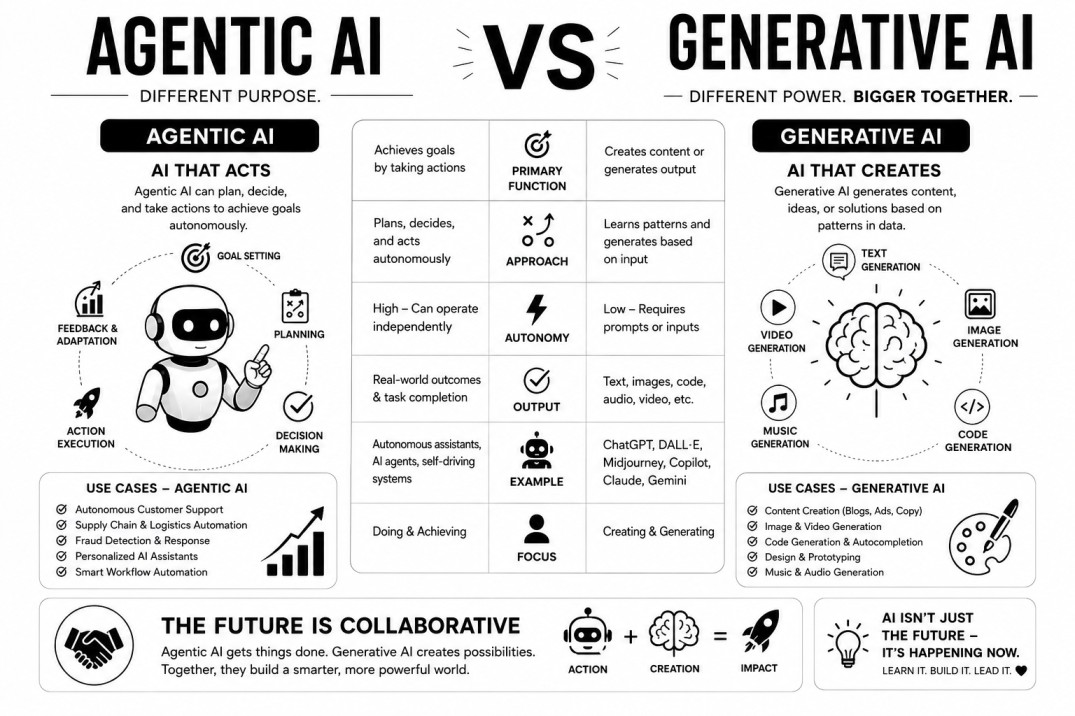
Agentic AI vs Generative AI
| Dimension | Generative AI | Agentic AI |
|---|---|---|
| Core function | Produces new content (text, image, audio, video, code) | Plans and executes multi-step tasks toward a goal |
| Autonomy level | Low — waits for a prompt each time | High — can act independently across steps |
| Interaction pattern | Single-turn or conversational, human-driven | Goal-driven, often runs with minimal supervision |
| Memory / state | Typically limited to a conversation window | Maintains state across a task, sometimes across sessions |
| Tool use | Optional, usually not required | Central — calls APIs, browses, runs code, uses software |
| Decision-making | Reactive (responds to input) | Proactive (chooses next steps, adapts to feedback) |
| Output | A finished artifact (text, image, etc.) | A completed outcome (task done, workflow executed) |
| Example | ChatGPT writing a blog post from a prompt | An AI agent researching competitors, drafting the post, formatting it, and publishing it |
| Underlying models | Often the same LLMs (GPT, Claude, Gemini) | Built on top of LLMs, plus planning, memory, and tool-orchestration layers |
| Human role | Prompt, review, iterate each step | Set the goal, review the outcome |
What Is Generative AI?
Generative AI refers to models trained to produce new content that resembles the data they were trained on. Give it a prompt, and it generates a response — a paragraph, an image, a snippet of code, a melody. The defining trait is that it’s fundamentally reactive: it responds to input and then stops.
Depending on the model and application, generative AI can produce:
- Text
- Images
- Audio
- Video
- Software code
- Summaries
- Marketing copy
- Presentations
- Data transformations
- Conversational responses
Large language models are a prominent example of generative AI. A user provides an instruction, and the model generates a response based on its learned patterns and the context available to it.
For example, a marketer might ask generative AI:
“Write five SEO-friendly product descriptions for a new wireless keyboard.”
The system can produce the requested descriptions almost immediately.
Generative AI is especially powerful when the desired result is a piece of content, an idea, a transformation, or a natural-language response.
How Generative AI Works
At a high level, a generative AI system processes an input and predicts or constructs an appropriate output.
In a language model, that may involve predicting sequences of tokens based on the context provided to the model. More advanced systems may combine models with retrieval, external tools, databases, or other software components.
The important point is that generative AI is generally optimized around producing an output, rather than independently managing an entire real-world workflow.
Examples of Generative AI
Common examples include:
- Writing a blog post
- Summarizing a meeting transcript
- Generating marketing slogans
- Creating an image from a description
- Translating text
- Generating computer code
- Drafting an email
- Answering questions
- Creating a product comparison
Generative AI can therefore be viewed as an AI content and reasoning layer.
What Is Agentic AI?
Agentic AI refers to AI systems that can act toward a defined goal by planning, making decisions, using tools, interacting with systems, and adapting based on results.
Rather than stopping after generating a response, an agentic system can determine what needs to happen next.
For example, consider this instruction:
Research five competitors, compare their pricing, identify gaps in their offerings, and prepare a report.
A basic generative AI interaction may provide guidance on how to perform this task.
An agentic system could potentially:
- Identify the required research steps.
- Search for relevant information.
- Collect competitor data.
- Organize the data.
- Compare pricing and features.
- Identify patterns and gaps.
- Generate a report.
- Check whether important information is missing.
- Revise the report.
- Deliver the final result.
The defining concept is goal-directed behavior.
Agentic AI is therefore less about producing one response and more about managing a sequence of actions that moves a task toward completion.
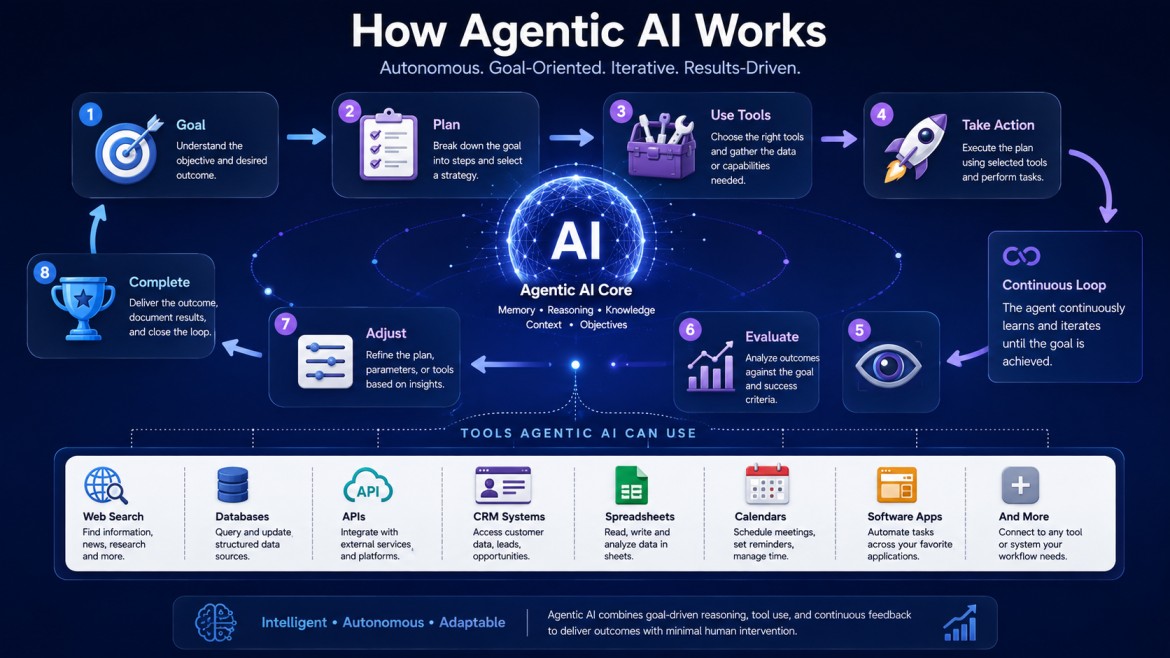
How agentic AI works
Agentic AI systems typically combine an LLM (as the “reasoning engine”) with additional components:
- Planning — breaking a high-level goal into ordered steps
- Memory — retaining context across steps or sessions, not just within one prompt
- Tool use — calling APIs, browsing the web, executing code, or operating software
- Reflection/evaluation — checking whether an action succeeded and deciding the next step
- Autonomy controls — guardrails that determine when the agent should ask for human approval versus proceed on its own
This loop — plan, act, observe, adjust — is what separates an agent from a simple chatbot.
Common examples of agentic AI
- Research agents that search the web, gather sources, and compile a report unprompted at each step
- Coding agents that read a codebase, write code, run tests, and fix bugs in a loop
- Customer service agents that look up account data, resolve a ticket, and escalate only if needed
- Workflow automation agents that manage multi-step business processes (e.g., processing an invoice from receipt to payment)
- Personal assistant agents that plan a trip — comparing flights, checking calendars, and booking — with minimal step-by-step instruction
What agentic AI is good at
- Multi-step tasks that would otherwise require constant human prompting
- Tasks requiring tool use (browsing, running code, calling APIs)
- Workflows where conditions change and the system needs to adapt
- Reducing the “babysitting” required to get from goal to finished outcome
Where agentic AI still needs guardrails
Autonomy introduces risk. An agent that can take real actions (send emails, spend money, modify files) can also make costly mistakes faster than a human would catch them. This is why most production agentic systems include checkpoints, permission scopes, and human-in-the-loop approval for high-stakes actions.
Agentic AI vs Generative AI: The Core Differences
1. Autonomy
Generative AI has no autonomy — it only acts when prompted, and only for the duration of that single response. Agentic AI is built specifically to reduce the need for constant prompting, taking a sequence of actions toward a goal.
2. Statefulness
A generative AI tool typically resets its working context between unrelated interactions. Agentic AI maintains state across an entire task — sometimes across days or multiple sessions — because it needs to remember what it already tried and what worked.
3. Tool use and real-world action
Generative AI produces content; it doesn’t inherently interact with other systems. Agentic AI is defined by its ability to use tools: querying a database, browsing a live website, executing code, or triggering an action in third-party software.
4. Decision-making structure
Generative AI decision-making is limited to “what’s the best next word/pixel/token.” Agentic AI decision-making includes “what’s the best next action” — a fundamentally different and more complex kind of reasoning that involves planning and re-planning.
5. Failure handling
If a generative AI output is wrong, a human notices and re-prompts. If an agentic AI step fails, the system itself is often designed to detect the failure and try a different approach before involving a human.
Agentic AI vs Generative AI Examples
The easiest way to understand the difference is through real-world scenarios.
| Scenario | Generative AI | Agentic AI |
|---|---|---|
| Marketing | Writes campaign copy | Plans campaign tasks and coordinates execution |
| Customer service | Drafts an answer | Retrieves account information, resolves an issue, and updates records |
| Sales | Writes outreach emails | Researches prospects, prioritizes leads, drafts messages, and updates CRM data |
| Software development | Generates code | Plans implementation, writes code, runs tests, analyzes failures, and iterates |
| Research | Summarizes sources provided | Searches multiple sources, compares findings, evaluates gaps, and produces a report |
| Finance operations | Explains financial data | Retrieves data, applies predefined workflows, flags exceptions, and prepares reports |
| Administration | Drafts a meeting agenda | Checks calendars, identifies conflicts, schedules a meeting, and sends invitations |
The distinction is not simply content vs no content.
Agentic AI can generate content too.
The difference is that the generated content may be just one component of a broader, action-oriented workflow.
Generative AI and Agentic AI Can Work Together
One of the most important concepts in modern AI is that generative AI and agentic AI are complementary rather than mutually exclusive.
An AI agent may use a generative AI model to:
- Interpret instructions
- Analyze text
- Generate plans
- Reason about possible actions
- Write messages
- Summarize information
- Produce code
- Evaluate potential responses
The agentic layer can then connect those capabilities to tools and workflows.
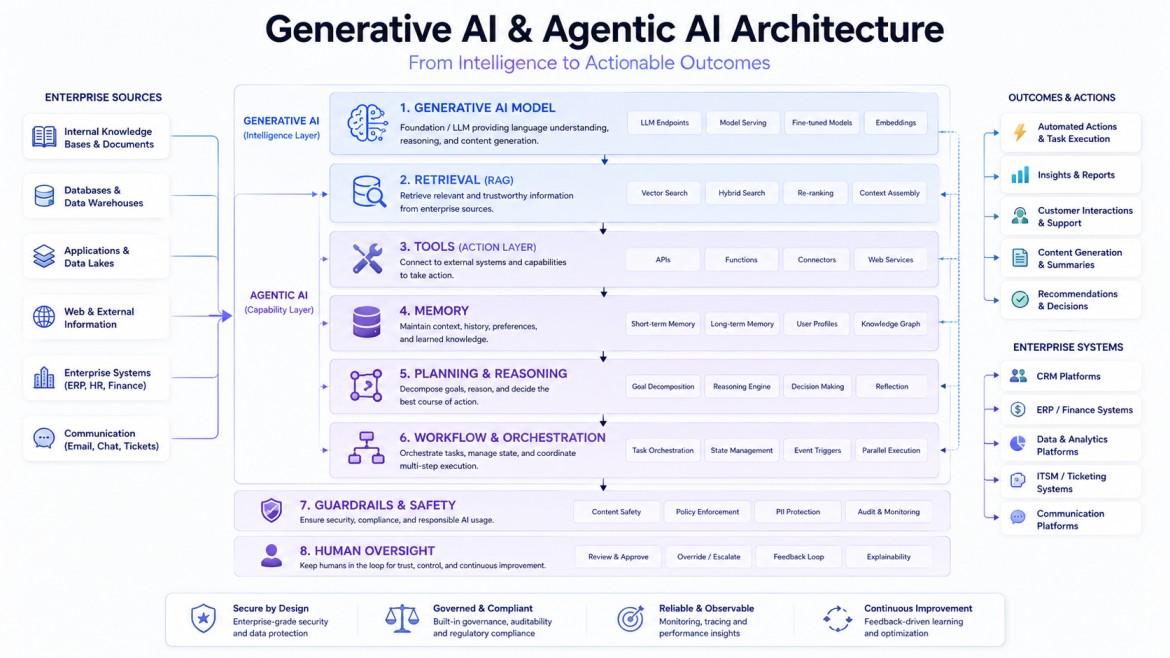
A simplified architecture might look like this:
User goal → AI model → planning → tool selection → action → observation → evaluation → next action → final outcome
This is why agentic AI is often better understood as a system architecture or operating pattern around AI models, rather than simply a bigger or more advanced language model.
Risks and Challenges Compared
| Risk Area | Generative AI | Agentic AI |
|---|---|---|
| Hallucination | Can produce inaccurate content | Can act on inaccurate conclusions, compounding errors across steps |
| Oversight needed | Per-response review | Ongoing monitoring, especially for high-stakes actions |
| Cost of mistakes | Usually low (a bad draft) | Can be higher (a wrong action taken in the real world) |
| Security surface | Limited to content output | Larger — includes tool access, API permissions, data access |
| Predictability | Fairly predictable per prompt | Less predictable across a multi-step chain |
Because agentic systems can take real actions, most well-designed implementations use scoped permissions, approval gates for irreversible actions, and detailed logging — treating autonomy as something to be earned incrementally, not assumed by default.
When Should a Business Use Generative AI?
Generative AI is often the better starting point when the goal is to improve employee productivity without giving the system extensive control over business operations.
Examples include:
Content teams: Blog drafts, social posts, outlines, editing, and repurposing.
Marketing teams: Campaign ideas, ad variations, audience messaging, and product copy.
Sales teams: Email drafts, call summaries, account research, and proposal support.
HR teams: Job descriptions, internal communications, and document summarization.
Developers: Code generation, documentation, debugging assistance, and test creation.
For many organizations, generative AI delivers value quickly because the human remains directly involved in the final decision.
When Should a Business Use Agentic AI?
Agentic AI becomes more compelling when a process contains multiple repeatable steps, defined goals, accessible tools, and measurable outcomes.
Good candidates may include:
- Customer service workflows
- Lead qualification
- Research pipelines
- Software testing
- Back-office operations
- Data reconciliation
- Document processing
- IT support
- Monitoring and alerting
- Procurement workflows
The strongest use cases tend to be processes where success can be clearly defined and the actions can be constrained.
For example:
Process every invoice according to these rules and flag exceptions
is usually easier to automate safely than:
Make whatever financial decisions seem best.
Agentic systems benefit from clear boundaries.
The Relationship Between Generative AI, AI Agents, and Automation
It is useful to distinguish three concepts.
Generative AI creates content or responses.
AI agents use AI capabilities to pursue goals through actions and decisions.
Automation executes predefined processes according to rules or triggers.
These technologies can overlap.
Traditional automation may follow a fixed path:
Trigger → Rule → Action
An agentic workflow may be more adaptive:
Goal → Plan → Action → Observation → Adjustment → Outcome
Generative AI can support both by providing natural-language understanding, content creation, reasoning, and interpretation.
This means organizations do not necessarily need to replace traditional automation with agents. In many cases, the strongest architecture combines deterministic automation with AI where flexibility is useful.
How to Choose Between Generative AI and Agentic AI
A practical decision framework is to ask five questions:
1. Is the desired output mainly content?
Choose generative AI.
2. Does the task require multiple steps?
Consider agentic AI.
3. Does the system need to interact with external tools?
An agentic architecture may be appropriate.
4. Can success be measured clearly?
The clearer the objective, the easier it is to design and evaluate an agent.
5. What happens if the system makes a mistake?
The higher the potential impact, the stronger the need for human approval, constrained permissions, validation, and monitoring.
FAQ
Is ChatGPT generative AI or agentic AI? A: By default, ChatGPT is generative AI — it responds to prompts one at a time. However, when given tools like web browsing, code execution, or plugins/connectors that let it take multi-step actions toward a goal, it starts exhibiting agentic behavior. Many modern AI products sit on a spectrum rather than a strict either/or.
Can agentic AI exist without generative AI? A: In practice, no. Nearly all modern agentic AI systems use a generative model (typically an LLM) as their reasoning core. The “agentic” part refers to the planning, memory, and tool-use layer built around that generative core — not a separate technology.
Is agentic AI more advanced than generative AI? A: It’s not more advanced so much as it solves a different problem. Generative AI focuses on producing high-quality content. Agentic AI focuses on autonomously completing multi-step tasks. Agentic systems are generally more complex to build and control, but “advanced” depends on what you’re trying to accomplish.
What are the biggest risks of agentic AI compared to generative AI? A: The main added risk is that agentic AI can take real-world actions — sending messages, spending money, modifying files, calling APIs — often across multiple steps without a human checking each one. A generative AI mistake is usually just a bad draft; an agentic AI mistake can compound across a chain of decisions before anyone notices.
Do businesses need agentic AI, or is generative AI enough? A: It depends on the workflow. If your bottleneck is producing content faster (copy, images, code snippets), generative AI alone may be sufficient. If your bottleneck is coordinating multi-step processes — data lookups, approvals, follow-ups — agentic AI is likely to deliver more value, provided it’s implemented with proper oversight.
What’s an example of agentic AI in everyday tools? A: AI coding assistants that read your codebase, write a fix, run your test suite, and iterate until the tests pass are a common example. So are research assistants that autonomously search multiple sources, cross-reference facts, and compile a report without step-by-step prompting.
How do agentic AI systems “remember” things across steps? A: They typically use a memory layer — this can be as simple as keeping a running log of actions and observations within a task, or as sophisticated as a persistent database the agent can read from and write to across sessions.
Will agentic AI replace generative AI tools? A: No — agentic AI is built on top of generative AI, not instead of it. As agentic systems become more common, the generative model underneath still does the core reasoning and content work; the agentic layer just adds planning, memory, and the ability to take action.
What skills should I learn to work with agentic AI? A: Understanding prompt design is still foundational, but agentic AI also rewards skills in task decomposition (breaking goals into steps), tool integration (APIs, function calling), and designing guardrails (permissions, approval flows) so autonomous systems stay safe and predictable.
Is AI agent the same thing as agentic AI? A: They’re closely related. An “AI agent” usually refers to a specific implementation — a system built to autonomously pursue a goal. “Agentic AI” is the broader category or approach that agents fall under.






I’ve been trying out a few platforms lately and this one really stands out for its smooth interface. Definitely worth a look for anyone seeking a reliable experience.