


If you have ever typed a question into a small pop-up window on a website and received an instant reply, you have already talked to a chatbot. These small pieces of software have quietly become one of the most common ways businesses communicate with their customers online. From answering simple questions about store hours to helping people book flights, track packages, or troubleshoot technical problems, chatbots are now everywhere.
But what exactly is a chatbot, how does it actually work, and why have so many companies adopted this technology? This guide breaks down everything you need to know about chatbots in plain, practical language — no technical background required.
What Is a Chatbot?
A chatbot is a computer program designed to simulate conversation with human users, usually through text or voice, in order to answer questions, complete tasks, or provide information automatically. Instead of waiting for a human employee to respond, a chatbot can reply instantly, 24 hours a day, without needing breaks, vacations, or sleep.
The word “chatbot” is a combination of “chat” (conversation) and “bot” (short for robot, meaning an automated program). Chatbots can appear in many places: on company websites, inside mobile apps, on messaging platforms like WhatsApp or Facebook Messenger, or even built into voice assistants like Siri and Alexa.
At its core, a chatbot’s job is simple: understand what a person is asking, and give a useful response — whether that response is a piece of information, a solution to a problem, or a next step in a process like making a purchase.
A Brief History of Chatbots
Chatbots are not a brand-new invention. Their roots go back several decades.
- 1966 – ELIZA: Often considered the first chatbot, ELIZA was created at MIT and simulated a psychotherapist by rephrasing users’ statements as questions. It had no real understanding of language, but it surprised many users with how “human” it felt.
- 1990s–2000s – Rule-based bots: As the internet grew, simple rule-based bots began appearing on websites, following scripted decision trees to answer basic questions.
- 2010s – Smart assistants: Siri, Google Assistant, Cortana, and Alexa introduced chatbot-like technology to everyday consumers through voice commands.
- 2016 onward – Messaging platform bots: Facebook Messenger, Slack, and other platforms opened their systems to third-party chatbots, leading to an explosion of business-focused bots for customer service and marketing.
- 2020s – AI-powered conversational agents: With advances in natural language processing and large language models, chatbots became dramatically more capable, able to hold flowing, human-like conversations, understand context, and generate original responses rather than relying only on pre-written scripts.
This evolution — from simple scripted responses to sophisticated AI-driven conversation — is the reason chatbots are now taken seriously as business tools rather than novelties.
How Do Chatbots Work?
Not all chatbots work the same way. Broadly speaking, there are three main approaches.
1. Rule-Based Chatbots
Rule-based chatbots, sometimes called “decision-tree” bots, follow a predefined set of rules and pathways. They are programmed to recognize specific keywords or phrases and respond with matching pre-written answers.
For example, if a user types “store hours,” the bot might be programmed to recognize that phrase and reply with the business’s operating hours. If the user asks something the bot was not programmed to understand, it typically responds with a generic message like “I’m sorry, I didn’t understand that” or offers to connect the user with a human agent.
Strengths: Predictable, easy to build, and reliable for narrow, well-defined tasks. Weaknesses: Cannot handle unexpected questions, phrasing variations, or complex conversations.
2. AI-Powered (NLP-Based) Chatbots
These chatbots use natural language processing (NLP), a branch of artificial intelligence that helps computers understand and interpret human language. Instead of matching exact keywords, NLP-based bots analyze the intent behind a message, even if it is phrased in an unusual or unexpected way.
For instance, “What time do you close?” and “When do you guys shut down for the day?” mean the same thing to a human, and a well-trained AI chatbot can recognize that similarity, even though the wording is completely different.
These systems typically rely on machine learning models trained on large amounts of text data. Some use a structured method involving “intents” (the purpose behind a message) and “entities” (specific details like dates, names, or locations) to extract meaning and generate an appropriate response.
Strengths: Flexible, can handle varied phrasing, improves over time with more data. Weaknesses: Requires more development effort, and quality depends heavily on training data.
3. Generative AI Chatbots
The newest and most advanced type of chatbot uses large language models (LLMs) — AI systems trained on massive amounts of text from books, websites, and other sources. Rather than choosing from a fixed set of pre-written responses, generative AI chatbots create original responses in real time, tailored to the specific conversation.
This is the technology behind many of today’s most capable conversational AI tools. These chatbots can maintain context across a long conversation, answer open-ended questions, summarize information, write content, and even reason through multi-step problems.
Strengths: Highly flexible, capable of nuanced and natural conversation, can handle a huge range of topics. Weaknesses: Can occasionally produce inaccurate information, may require careful oversight in sensitive use cases like healthcare or finance.
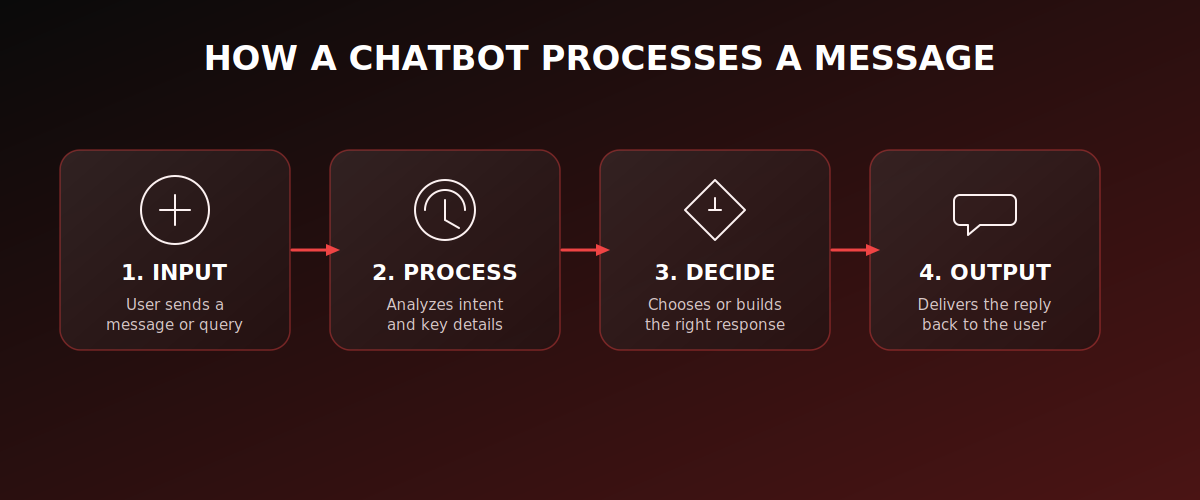
The Basic Anatomy of a Chatbot Conversation
Regardless of the type, most chatbot interactions follow a similar structure:
- Input: The user sends a message — typed text, a selected menu option, or spoken words.
- Processing: The chatbot analyzes the input to determine the user’s intent (what they want) and any relevant details (entities).
- Decision: Based on the analysis, the chatbot decides how to respond — pulling from a database, calling an external system (like a shipping tracker), or generating a new response.
- Output: The chatbot delivers its response back to the user, often along with buttons, links, or other interactive elements.
- Follow-up: The conversation continues, with the chatbot maintaining context so the discussion feels coherent rather than disjointed.
Types of Chatbots by Purpose
Beyond the technical distinction between rule-based, NLP-based, and generative AI chatbots, it helps to think about chatbots by what they are designed to do.
Customer Support Chatbots
These bots handle common customer questions, troubleshoot issues, process returns, or escalate complex problems to human agents. They are widely used by e-commerce companies, banks, telecom providers, and software companies to reduce wait times and support costs.
Sales and Lead Generation Chatbots
These bots engage website visitors, answer product questions, recommend items, and guide users toward a purchase or a signup form. They are often the first point of contact for potential customers.
Booking and Scheduling Chatbots
Common in industries like healthcare, hospitality, and travel, these bots help users book appointments, reserve hotel rooms, or schedule services without needing to call or fill out lengthy forms.
Internal/Enterprise Chatbots
Many organizations use chatbots internally to help employees find company policies, submit IT tickets, check payroll information, or navigate HR processes.
Social and Entertainment Chatbots
Some chatbots exist purely for engagement, entertainment, or companionship, allowing users to chat casually, play games, or explore creative writing.
Voice Assistants
While technically a specialized category, voice-based chatbots like Siri, Alexa, and Google Assistant apply similar conversational AI principles to spoken interactions rather than typed text.
Why Businesses Use Chatbots
Chatbots have grown popular for several practical reasons.
1. 24/7 Availability
Unlike human employees, chatbots do not need to sleep, take breaks, or go on vacation. This means customers can get help at any hour, which is especially valuable for businesses with a global customer base across different time zones.
2. Instant Response Times
Waiting on hold or for an email reply can be frustrating. Chatbots respond immediately, which significantly improves the customer experience for simple, common questions.
3. Cost Savings
Handling a large volume of repetitive questions with human agents is expensive. Chatbots can manage routine inquiries at a fraction of the cost, freeing up human staff to focus on complex or sensitive issues that genuinely require a human touch.
4. Scalability
A chatbot can handle thousands of simultaneous conversations without any drop in quality or speed — something that would require hiring an enormous support team if done manually.
5. Consistency
Chatbots deliver the same quality of information every time, reducing the risk of human error or inconsistent messaging across different support agents.
6. Data Collection and Insights
Every chatbot conversation generates data. Businesses can analyze this data to understand common customer pain points, frequently asked questions, and opportunities to improve products or services.
Common Uses of Chatbots in Everyday Life
Chatbots have quietly integrated into daily life in ways many people do not even notice. Here are some familiar examples:
- E-commerce: Asking a store’s website chatbot about order status, return policies, or product recommendations.
- Banking: Checking account balances, reporting lost cards, or asking about loan eligibility through a bank’s app.
- Healthcare: Scheduling appointments, checking symptoms through a preliminary triage bot, or receiving medication reminders.
- Travel: Booking flights, checking in for a flight, or getting real-time updates about delays.
- Food delivery: Placing orders, tracking deliveries, or resolving issues with an order through an app’s built-in chatbot.
- Education: Answering student questions, providing tutoring support, or helping with administrative tasks like registration.
Chatbots vs. Virtual Assistants: What’s the Difference?
The terms “chatbot” and “virtual assistant” are often used interchangeably, but there are subtle distinctions.
A chatbot is generally a narrower tool focused on conversation — answering questions and completing simple, well-defined tasks, often within a specific app or website.
A virtual assistant (like Siri, Alexa, or Google Assistant) tends to be broader in scope, capable of managing schedules, controlling smart home devices, setting reminders, and interacting across multiple platforms and services, often through voice.
In practice, the line between the two continues to blur as chatbot technology becomes more advanced and capable of handling increasingly complex, multi-step tasks.
Advantages of Chatbots
To summarize the key benefits:
- Provide instant, round-the-clock customer support
- Reduce operational costs for businesses
- Handle high volumes of simultaneous conversations
- Improve customer satisfaction through fast response times
- Free up human employees for complex, high-value tasks
- Offer consistent, accurate information
- Collect valuable data on customer needs and behavior
- Support multiple languages, expanding global reach
Limitations and Challenges of Chatbots
Despite their benefits, chatbots are not perfect. It is important to understand their limitations too.
Misunderstanding Complex Requests
Even advanced chatbots can misinterpret unusual phrasing, sarcasm, or highly specific technical questions, leading to frustrating experiences if not properly designed with fallback options to human support.
Lack of Emotional Nuance
While AI chatbots have improved at recognizing tone and sentiment, they still cannot fully replicate genuine human empathy, which matters greatly in sensitive situations like healthcare concerns or emotional customer complaints.
Over-Reliance Risks
Businesses that rely too heavily on chatbots without offering an easy path to human support risk alienating customers who need more personalized help.
Accuracy Concerns with Generative AI
Generative AI chatbots can sometimes produce responses that sound confident but are factually incorrect — a phenomenon often referred to as “hallucination.” This makes human oversight important, especially in fields like medicine, law, or finance.
Privacy and Security Considerations
Since chatbots often handle personal information (order details, account numbers, health data), businesses must ensure proper security measures and comply with data protection regulations.
How to Choose the Right Type of Chatbot
If you are a business owner or developer considering adding a chatbot, the right choice depends on your specific needs.
- Simple, narrow use case (like FAQs or store hours) → A rule-based chatbot may be sufficient and cost-effective.
- Moderate complexity with varied user phrasing (like customer support across many topics) → An NLP-based chatbot offers more flexibility.
- Open-ended, dynamic conversations (like a knowledgeable assistant that can handle a wide range of topics) → A generative AI chatbot provides the most natural and capable experience.
It is also worth considering integration needs (does the chatbot need to connect with your CRM, inventory system, or booking software?), language support, and how easily the bot can hand off conversations to human agents when needed.
The Future of Chatbots
Chatbot technology continues to evolve rapidly. Several trends are shaping where this technology is headed:
- More natural conversations: As underlying AI models improve, chatbots increasingly feel less robotic and more like talking to a knowledgeable, attentive assistant.
- Multimodal capabilities: Newer chatbots can process not just text, but also images, documents, and voice, allowing for richer interactions.
- Deeper personalization: Chatbots are becoming better at remembering context and preferences within a conversation to tailor responses more precisely.
- Integration with business systems: Chatbots increasingly connect directly with databases, calendars, and payment systems to complete entire tasks, not just answer questions.
- Proactive assistance: Rather than only responding when asked, future chatbots may proactively notify users about relevant updates, such as a shipping delay or an upcoming appointment.
Final Thoughts
Chatbots have come a long way from simple scripted programs to sophisticated conversational tools powered by artificial intelligence. Whether it is a basic rule-based bot answering FAQs or an advanced generative AI system holding a fluid, human-like conversation, chatbots serve one core purpose: making communication faster, more accessible, and more efficient.
For businesses, chatbots offer a practical way to improve customer experience while reducing costs. For everyday users, they provide quick, convenient answers without the wait. As AI technology continues to advance, chatbots will likely become even more capable, more natural to interact with, and more deeply woven into the digital services we use every day.
Understanding what a chatbot is — and how it works — is the first step toward using this technology effectively, whether you are a business looking to improve customer service or simply a curious user wanting to understand the tools you interact with daily.




[…] AI-powered app, on the other hand, includes AI as a feature. For example, it might contain an AI chatbot, document summarizer, recommendation engine, image analyzer, or writing assistant. These two […]