Artificial intelligence has moved from an experimental tool to a core part of how effective managers plan, communicate, and make decisions.
Managers do not need to become AI engineers to use artificial intelligence effectively. They do need to understand what AI can do, where it can fail, how employees should use it, which tasks should be automated, and where human judgment must remain central.
The most effective managers treat AI as a capability that can augment people and redesign work, rather than simply as a tool for generating text.
Research and guidance from organizations including NIST and the OECD emphasize the importance of trustworthy AI, human oversight, transparency, accountability, privacy, security, and risk management. Meanwhile, workplace research increasingly points toward teams in which humans and AI systems work together on increasingly complex tasks.
What Is AI for Managers?
AI for managers means using artificial intelligence to improve management activities such as planning, analysis, communication, decision-making, employee support, workflow optimization, forecasting, and productivity while maintaining appropriate human oversight.
For managers, AI can include:
- Generative AI
- AI assistants and copilots
- AI agents
- Predictive analytics
- Automated reporting
- Intelligent workflow automation
- Customer and employee analytics
- Forecasting systems
- Document analysis
- Meeting and communication tools
- Knowledge-management systems
- AI-powered decision-support tools
Why Is AI Important for Managers?
AI is important for managers because it can reduce repetitive work, accelerate analysis, increase access to information, support decision-making, and allow employees to spend more time on higher-value activities.
Three forces are driving this:
Employee adoption is outpacing manager adoption. Many team members already use AI tools daily; managers who can’t evaluate or guide that use lose credibility and oversight.
Competitive pressure. Teams using AI well are shipping faster and cutting reporting overhead, which raises the baseline expectation across an industry.
Decision quality. AI-assisted forecasting and data synthesis reduce the guesswork in resourcing, hiring, and prioritization decisions.
Managers who treat AI literacy as optional risk falling behind peers who use it to reclaim hours each week for higher-value work like coaching and strategy.
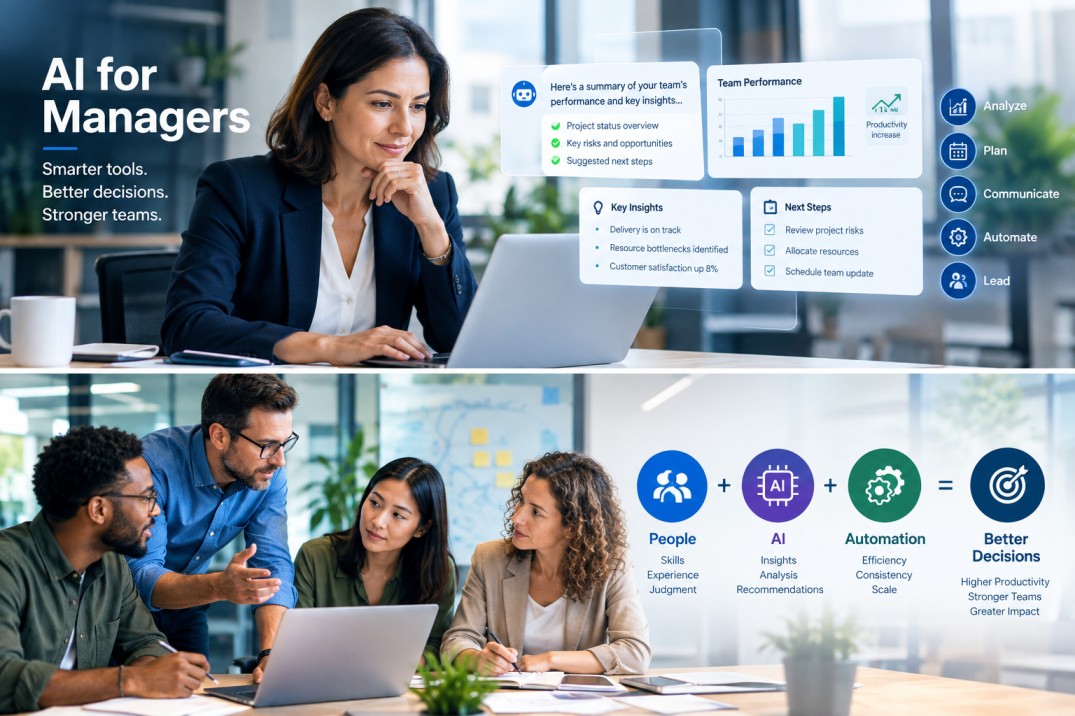
People + AI assistants + automated workflows + AI agents + business systems.
What Can AI Do for Managers?
The following table shows common applications.
| Management Area | AI Use Case | Potential Benefit | Human Role |
|---|---|---|---|
| Planning | Generate scenarios and plans | Faster planning | Select and validate strategy |
| Meetings | Summarize discussions and actions | Less administrative work | Confirm decisions |
| Reporting | Analyze large amounts of information | Faster insights | Interpret implications |
| Communication | Draft emails and announcements | Save time | Review tone and accuracy |
| HR | Analyze workforce information | Identify trends | Make people decisions |
| Sales | Summarize customer information | Better preparation | Manage relationships |
| Marketing | Generate content ideas | Increase creative capacity | Maintain brand quality |
| Operations | Identify process bottlenecks | Improve efficiency | Redesign workflows |
| Finance | Analyze reports and forecasts | Faster financial analysis | Apply financial judgment |
| Customer service | Summarize interactions | Faster resolution | Handle exceptions |
| Knowledge management | Retrieve organizational information | Reduce search time | Verify important information |
| Project management | Track actions and risks | Improve visibility | Prioritize resources |
AI should increase managerial leverage, not eliminate managerial responsibility.
Can AI Help Managers Make Better Decisions?
AI can support better decisions by organizing information, identifying patterns, comparing options, generating scenarios, and challenging assumptions, but AI should not automatically replace human judgment in consequential decisions.
A useful decision model is:
AI generates possibilities → AI organizes evidence → humans evaluate evidence → humans make or approve decisions.
Managers can ask AI questions such as:
- What assumptions are we making?
- What evidence would disprove this conclusion?
- What risks have we overlooked?
- What are the likely second-order effects?
- What alternative explanations exist?
- Which information is missing?
- What would a skeptical executive ask?
- What could go wrong with this strategy?
This turns AI from a simple content generator into a decision-support tool.
The distinction matters.
AI can help a manager think more broadly without necessarily becoming the final decision-maker.
hink more broadly without necessarily becoming the final decision-maker.
What Should Managers Not Delegate to AI?
Managers should be cautious about delegating decisions involving significant human consequences, sensitive information, legal obligations, employment decisions, safety, or strategic accountability without appropriate human review and organizational controls.
Examples can include:
- Hiring decisions
- Employee termination
- Performance judgments
- Disciplinary action
- Sensitive employee investigations
- Compensation decisions
- High-impact customer decisions
- Safety-critical decisions
- Legal conclusions
- Strategic commitments
- Decisions involving confidential information
The exact controls required depend on the organization, industry, jurisdiction, and use case.
The OECD AI Principles emphasize human agency and oversight, transparency, privacy, fairness, security, and accountability. citeturn0search0
The practical management principle is:
Automate tasks before you automate accountability.
How Can Managers Manage AI Risk?
Managers can manage AI risk by identifying the purpose of each AI system, limiting inappropriate data access, establishing review requirements, testing outputs, documenting important decisions, and assigning clear accountability.
NIST’s AI Risk Management Framework is designed to help organizations incorporate trustworthiness considerations into the design, development, use, and evaluation of AI systems. Its generative-AI profile provides additional guidance for managing risks associated with generative AI.
A practical manager’s AI risk checklist is:
| Risk | Manager Question | Control |
|---|---|---|
| Accuracy | Could the output be wrong? | Human review |
| Privacy | Does the AI receive sensitive information? | Data controls |
| Security | Could information be exposed or misused? | Access restrictions |
| Bias | Could outputs unfairly affect people? | Testing and review |
| Confidentiality | Is proprietary information being submitted? | Approved tools |
| Accountability | Who owns the final decision? | Named decision-maker |
| Transparency | Do affected people understand AI’s role? | Disclosure where appropriate |
| Compliance | Are there applicable laws or policies? | Legal/compliance review |
| Reliability | Does the system perform consistently? | Testing and monitoring |
The purpose is not to eliminate all AI risk. It is to manage risk proportionately to the potential impact.
How can AI improve team communication and one-on-ones?
AI can assist managers prepare for one on ones by summarizing past conversations , surfacing patterns in feedback, and drafting talking points — but it should never replace the actual conversation.
Practical applications include:
- Summarizing notes from the live three one on ones to spot recurring themes .
- Drafting a first version of written feedback , which the manager then personalizes .
- Preparing instructive questions ahead of a rough conversation .
- Translating theoretical updates into evident language for cross functional stakeholders .
The risk to watch for: over relying on AI drafted feedback can make communication feel generic or impersonal . The best practice is to use AI to prepare and structure, then deliver the message in your own voice .
What Is the Difference Between AI Automation and AI Augmentation?
AI automation means AI performs a task with limited human intervention, while AI augmentation means AI supports a human who remains actively involved in the task or decision.
| Approach | Description | Example |
|---|---|---|
| Manual | Human performs task | Manager writes report |
| AI-assisted | AI helps human | AI creates first draft |
| AI-augmented | AI performs substantial analysis | AI identifies trends for manager review |
| Automated | System performs workflow | AI classifies and routes requests |
| Agentic | AI performs multiple connected actions | AI researches, plans, executes defined workflow and reports results |
Managers should select the appropriate level of automation.
Not every task should become fully automated.
How much time can AI actually save managers each week?
Most managers who adopt AI consistently for communication, reporting, and meeting prep report saving between five and ten hours per week within the first two months.
That estimate is conservative and task-dependent. The largest gains typically come from:
- Reducing time spent writing first drafts of reports, emails, and reviews
- Cutting meeting-follow-up time through automated summaries and action-item extraction
- Speeding up initial research or competitive analysis
The time saved is only valuable if it’s redirected toward high-leverage work — coaching, strategic planning, or stakeholder relationships — rather than simply absorbed into more meetings.
What Are the Biggest AI Mistakes Managers Make?
The biggest mistakes include adopting AI without a clear business problem, trusting outputs without verification, ignoring employee concerns, failing to establish data rules, and measuring tool usage instead of business results.
Common mistakes include:
1. Buying tools before defining problems
Technology should follow business needs.
2. Assuming AI is always accurate
AI systems can produce plausible but incorrect outputs.
3. Automating the wrong process
Automating a poorly designed workflow can make a bad process faster rather than better.
4. Ignoring employees
Employees understand the practical realities of workflows better than executives or software vendors often do.
5. Treating AI as purely technical
Successful adoption is also a people, process, governance, and leadership challenge.
6. Failing to establish accountability
Someone must remain responsible for consequential outcomes.
7. Measuring activity rather than value
The number of prompts generated is not a meaningful business outcome.
FAQ
Do managers need to learn coding to use AI?
No. Most managers can gain significant value from AI without becoming programmers. AI literacy, task design, critical evaluation, data awareness, and workflow thinking are generally more important starting skills.
How can managers use ChatGPT at work?
Managers can use ChatGPT and similar generative AI tools for brainstorming, drafting, summarizing, analyzing provided information, preparing meeting materials, creating plans, developing questions, and exploring alternative approaches.
Organizations should establish rules regarding confidential, personal, regulated, and proprietary information before employees submit business data to an AI system.
Can AI replace managers?
AI can automate or support some managerial activities, but management also involves judgment, accountability, relationships, coaching, negotiation, leadership, and context. The more realistic question is how AI will change the activities managers perform.
What is the biggest benefit of AI for managers?
The biggest potential benefit is increased managerial leverage: AI can reduce low-value administrative work and help managers devote more time to strategic, interpersonal, and high-value activities.
What is the biggest risk of AI for managers?
The biggest risk is using AI without appropriate judgment, governance, verification, or accountability. Errors become particularly serious when AI influences consequential decisions about people, customers, finances, safety, or compliance.
Should managers trust AI-generated information?
No—not automatically. AI output should be evaluated according to the importance of the task. High-impact decisions require stronger verification than low-risk brainstorming.
Can AI improve employee productivity?
Yes, AI can improve productivity when it is integrated into well-designed workflows. The result depends on the task, technology, employee capability, implementation quality, and measurement approach.
How should managers train employees to use AI?
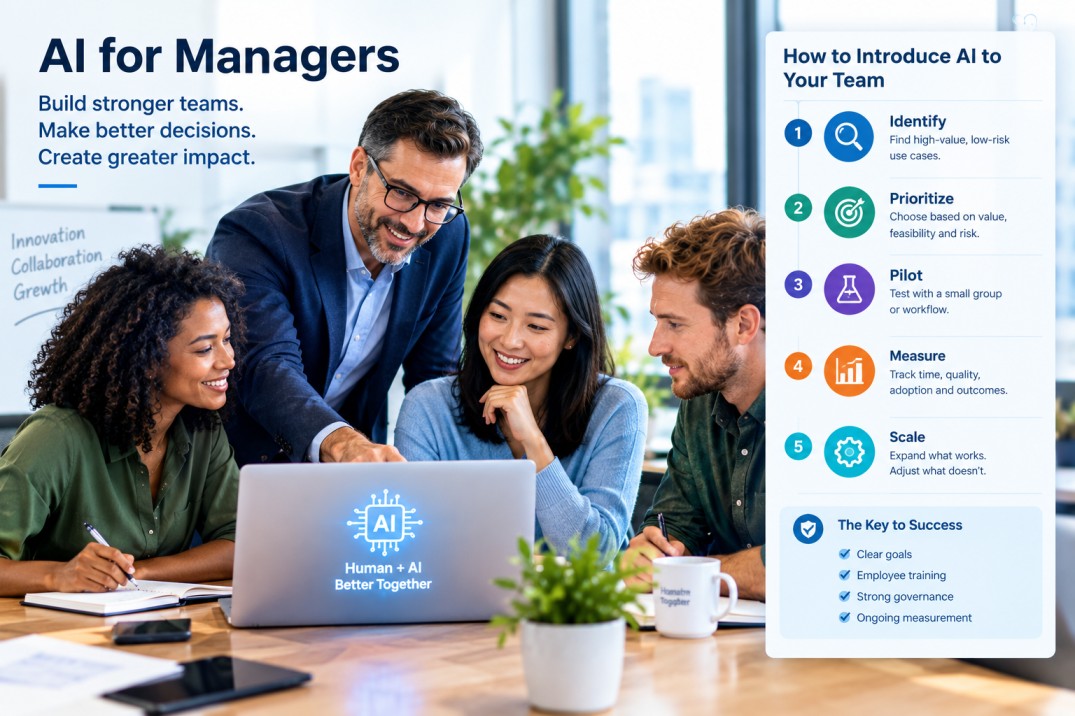
Start with practical workflows rather than abstract AI theory. Teach employees how to identify suitable tasks, provide context, protect sensitive information, evaluate outputs, and escalate uncertain situations.
What is AI governance?
AI governance is the set of policies, processes, roles, controls, and accountability mechanisms used to ensure AI is developed or used appropriately.
The Future of AI for Managers
The future of management is unlikely to be simply “managers using AI.”
It is more accurately described as:
Managers designing organizations in which humans and AI systems work together.
This distinction matters.
AI can potentially increase the amount of information a manager can process, the number of workflows a team can operate, and the speed at which organizations experiment.
But increased capability creates increased responsibility.