AI for research is changing how students, academics, professionals, writers, and independent researchers find information, evaluate evidence, analyze data, and develop ideas. Used well, artificial intelligence can reduce repetitive research work, uncover relevant sources faster, organize large amounts of information, and help researchers move from a broad question to a structured understanding of a topic.
However, AI should not be treated as a replacement for research judgment.
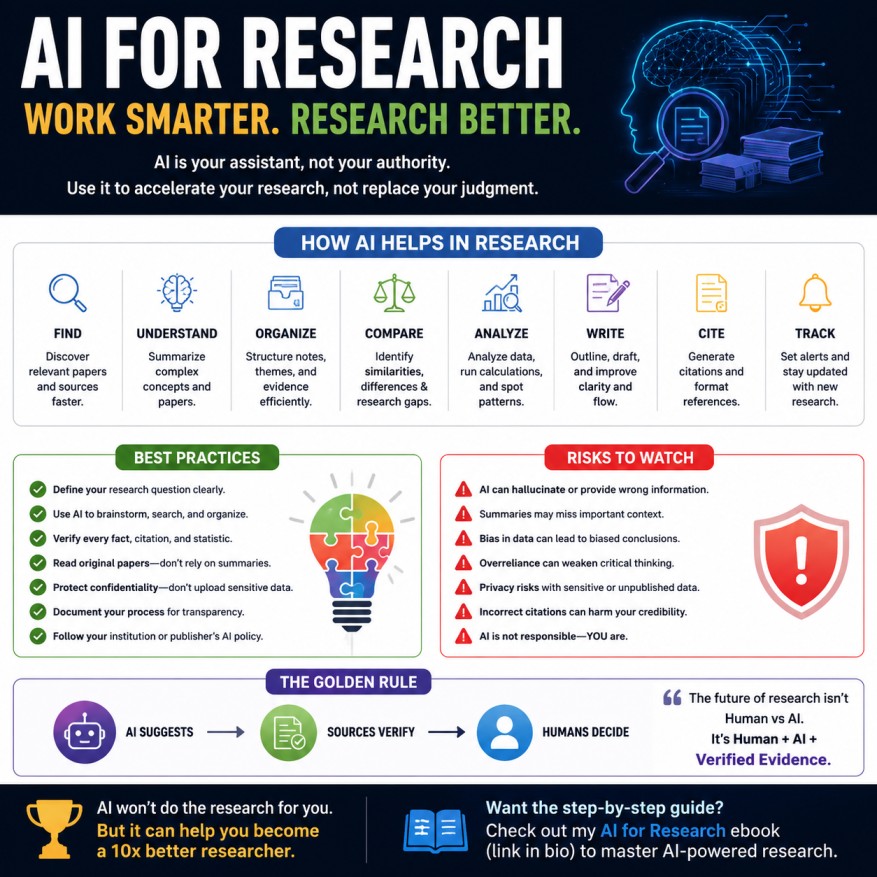
The most reliable approach is to use AI as a research assistant rather than a research authority. AI can help identify patterns, summarize literature, suggest search strategies, compare sources, extract information, and improve writing. The researcher remains responsible for checking original sources, assessing evidence quality, identifying limitations, and making the final conclusions.
The International Committee of Medical Journal Editors says AI-generated material can be incorrect and that humans remain responsible for the accuracy and integrity of submitted work.
What Is AI for Research?
AI for research means using artificial intelligence tools to support one or more stages of the research process, including question development, literature discovery, source analysis, data organization, synthesis, writing, and communication.
For example, a researcher can use an AI-powered research platform to identify potentially relevant academic papers, group studies by themes, extract information from documents, generate an initial evidence map, or identify disagreements between studies.
Some specialized research platforms are explicitly designed around these workflows. Elicit, for example, describes functionality for literature discovery, research reports, systematic reviews, screening, data extraction, and research alerts.
The important distinction is between accelerating research tasks and outsourcing research judgment. AI can make research faster. It does not automatically make the research correct.

How Can AI Be Used in the Research Process?
A practical AI-assisted research workflow looks like this:
Question → Search → Screen → Extract → Compare → Analyze → Synthesize → Verify → Write
Each stage requires a different level of human involvement.
1. Research Question Development
AI can help transform a broad topic into a focused research question.
For example:
I want to research remote work.
That is a topic, not yet a strong research question.
AI can help generate narrower questions such as:
How has hybrid work affected employee productivity in knowledge-intensive organizations since 2020?”
The researcher should then assess whether the question is specific, measurable, feasible, and supported by available evidence.
AI is most useful here as a thinking partner.
2. Literature Discovery
AI can accelerate literature discovery by helping researchers identify relevant concepts, keywords, papers, and connections between studies.
Specialized research tools can also organize papers into structured workflows. Elicit, for example, says its search and review features can help researchers discover papers, synthesize evidence, screen studies, extract information, and monitor new research.
But an AI-generated list of sources should be treated as a starting point.
Every important paper should be opened and checked.
A strong workflow is:
- Ask AI to suggest search concepts.
- Search authoritative databases.
- Identify primary research and major reviews.
- Verify titles, authors, publication dates, and journals.
- Read the original sources.
- Record the evidence in a research database or reference manager.
How Do You Use AI to Find Academic Papers?
The safest approach is to use AI to expand and organize a literature search, then verify important sources in established scholarly databases or the original publications.
A useful search process is:
Step 1: Define the research question
Write one sentence describing exactly what you need to know.
Step 2: Identify concepts
Break the question into major concepts, variables, populations, contexts, and outcomes.
Step 3: Generate alternative terminology
AI can help identify synonyms, related terminology, abbreviations, historical terminology, and discipline-specific language.
Step 4: Search academic databases
Depending on the subject, this could include databases such as PubMed, Web of Science, Google Scholar, IEEE Xplore, or specialist databases.
Step 5: Use AI for organization
AI can help classify papers according to criteria such as:
Research question
Methodology
Population
Step 6: Verify the originals
Never assume that an AI summary is an accurate representation of a paper until you have checked the source.
What Are the Best AI Research Tools?
The best AI research tool depends on the research task rather than the popularity of the tool.
A general-purpose chatbot may be useful for brainstorming and explanation, while specialized research platforms can be better suited to literature discovery and evidence synthesis.
| Tool category | Best use | Main advantage | Main caution |
|---|---|---|---|
| General AI assistants | Brainstorming, outlining, explanations | Flexible | May produce unsupported claims |
| AI academic search tools | Finding papers | Faster discovery | Coverage varies |
| Literature-review platforms | Evidence synthesis | Structured workflows | Outputs require verification |
| Reference managers | Organizing sources | Citation management | AI does not replace source evaluation |
| Coding assistants | Data analysis and scripting | Faster development | Code and results require testing |
| Document-analysis AI | Extracting information from PDFs | Faster document review | Extraction can contain errors |
| Data-analysis tools | Exploring datasets | Faster repetitive analysis | Statistical judgment remains human |
| Knowledge-management tools | Research notes | Connect ideas and sources | Quality depends on research organization |
One useful example is Elicit, which currently describes research-agent, literature-review, paper-search, systematic-review, library, and alert capabilities.
Researchers should evaluate tools based on source coverage, traceability, citation quality, privacy, reproducibility, integration with existing workflows, and accuracy rather than simply asking which tool is the best.
Can AI Be Trusted for Research?
AI should not be treated as a source of truth. It should be treated as an assistant whose output requires verification.
Generative AI can produce fluent and convincing answers that contain factual errors, missing context, biased interpretations, or invented citations
How Can Researchers Avoid AI Hallucinations?
Researchers can reduce hallucinations by requiring traceable sources, checking original documents, asking AI to distinguish evidence from inference, and independently verifying important claims.
A practical verification protocol is:
| Claim type | Verification method |
|---|---|
| Academic finding | Read the original paper |
| Statistic | Check the table or dataset |
| Quote | Locate the exact passage |
| Citation | Verify title, author, journal, year, and identifier |
| Scientific claim | Check authoritative literature |
| Legal statement | Check current primary legal source |
| Current event | Check recent authoritative reporting |
| Historical claim | Compare reliable reference sources |
| AI-generated analysis | Recalculate or independently test |
A useful prompt is:
“For every factual claim, identify the supporting source and clearly distinguish what the source states from what you infer.”
Even then, the researcher should inspect the evidence independently.
Can You Upload Research Papers to AI?
You can analyze research papers with AI when the tool, copyright permissions, institutional policies, and confidentiality requirements allow it, but confidential or sensitive material should not be uploaded to an unsecured AI system.
This is especially important for:
- Unpublished manuscripts
- Peer-review material
- Confidential datasets
- Participant information
- Client records
- Proprietary research
- Restricted reports
- Sensitive intellectual property
Nature’s 2026 guidance warns against uploading confidential peer-review material into public or unsecured AI systems.
Before uploading a document, ask:
Do I have permission to share this document with this service?
And:
Do I understand how the service handles uploaded information?
How Can AI Make Research Faster?
AI makes research faster by reducing repetitive work such as searching, sorting, extracting, summarizing, formatting, and coding.
The biggest productivity gains usually come from workflow design rather than a single prompt.
For example:
Inefficient workflow
Search → open papers → take random notes → forget where information came from → rewrite everything later.
AI-assisted workflow
Research question → structured search → source database → evidence matrix → AI-assisted extraction → human verification → synthesis → final writing.
The second workflow creates a traceable chain between claims and sources.
That traceability is more important than generating a large volume of text.
AI Research Prompt Framework
A reliable research prompt can follow this formula:
Role + Context + Task + Evidence + Constraints + Output
For example:
Act as a research assistant specializing in systematic evidence synthesis. I am investigating [topic]. Identify the major evidence relevant to [question]. Use only the sources provided. Distinguish evidence, interpretation, and uncertainty. Do not invent citations. Return the results as an evidence table followed by a concise synthesis.
This approach produces a much more useful output than simply asking AI to research the topic.
What Are the Risks of Using AI in Academic Research?
| Risk | Description | Mitigation |
|---|---|---|
| Hallucinated citations | AI can invent plausible-sounding but nonexistent papers or misattribute real findings | Always verify every citation against the original source |
| Academic integrity violations | Submitting AI-generated text as original work without disclosure | Follow your institution’s AI policy; disclose assistance |
| Bias in training data | AI models can reflect biases present in their training data, skewing summaries or framing | Cross-reference with multiple sources and diverse perspectives |
| Over-reliance | Reduced critical engagement with source material | Use AI as a starting point, not an endpoint, for analysis |
| Outdated information | Models have knowledge cutoffs and may not reflect the most recent research | Use AI tools with live web search or dedicated academic databases for current literature |
| Data privacy | Uploading unpublished data or manuscripts to AI tools may violate confidentiality agreements | Check terms of service; avoid uploading sensitive or embargoed data |
What Is the Future of AI for Research?
The future of AI for research is likely to involve increasingly integrated research agents that can search sources, organize evidence, analyze documents, run technical workflows, and support researchers throughout the research lifecycle.
Research platforms are already moving toward more autonomous workflows. Elicit, for example, has expanded its research-agent, systematic-review, and API capabilities during 2026.
At the same time, scientific publishing organizations continue to emphasize that AI should support rather than replace independent scholarly judgment.
The likely long-term model is therefore not:
Human OR AI
but:
Human + AI + verified evidence
The human defines the problem, evaluates significance, makes methodological decisions, verifies evidence, and accepts responsibility for the conclusions.
AI increasingly handles portions of the information-processing workload.
AI for Research: Best Practices Checklist
Before publishing or submitting AI-assisted research, ask:
| Question | Check |
|---|---|
| Did I define the research question clearly? | ✓ |
| Did I search beyond one AI system? | ✓ |
| Did I verify important sources? | ✓ |
| Did I read original research where necessary? | ✓ |
| Did I check statistics and quotations? | ✓ |
| Did I distinguish facts from AI-generated interpretation? | ✓ |
| Did I protect confidential information? | ✓ |
| Did I follow my institution or publisher’s AI policy? | ✓ |
| Did I disclose AI use where required? | ✓ |
| Can I explain and reproduce my research process? | ✓ |
| Am I personally responsible for the final conclusions? | ✓ |
This checklist reflects the broader direction of current research and publishing guidance: AI can assist, but accountability remains human.
FAQ
What is the best AI for research?
There is no single best AI research tool for every task. General AI assistants are useful for brainstorming and explanations, while specialized research platforms can be more suitable for literature discovery, screening, evidence extraction, and synthesis.
Can AI do research for me?
AI can perform many research tasks, but it should not independently replace scholarly judgment. The researcher should define the question, evaluate the evidence, verify important claims, and make the final conclusions.
Can AI summarize academic papers?
Yes. AI can summarize papers and extract specified information, but summaries should be checked against the original document, especially for important findings, limitations, statistics, and conclusions.
Can AI write a research paper?
AI can assist with outlines, drafts, editing, summaries, and explanations, but researchers remain responsible for accuracy, originality, citations, and compliance with institutional or publisher requirements.
Does AI make research more accurate?
Not automatically. AI can make research faster and more organized, but it can also introduce errors. Accuracy depends on source quality, verification, methodology, and human oversight.
What is the biggest problem with AI research?
The biggest problem is that AI can produce confident-sounding information that is incorrect or poorly supported. This makes source verification essential.